- Home
- Health
- Health issues
- A to Z
- Measles
- About measles
About measles
Measles circulates around the world.
There is currently no measles outbreak in Québec. However, people may have been exposed to a contagious traveler between September 17 and 20, 2026.
To find out the places of possible exposure to a case of measles, the people at risk and the measures to be taken, visit the page Measles outbreak.
Description
Measles is a serious and highly contagious disease. Measles is an airborne disease which spreads when an infected person breathes, coughs, sneezes, or speaks.
Measles was widespread in North America. It has become rarer because of the effectiveness of immunisation campaigns. Even today, Québec sometimes experiences outbreaks of measles.
Measles remains one of the major causes of death among young children globally. Yet there is a safe and effective vaccine against this disease.
Symptoms
The first symptoms of measles are the following:
- Fever
- Nasal congestion with runny nose
- Cough
- Conjunctivitis (red watery eyes)
- Eyes sensitive to light
- General discomfort
Subsequently, a rash develops on the face and then the body.

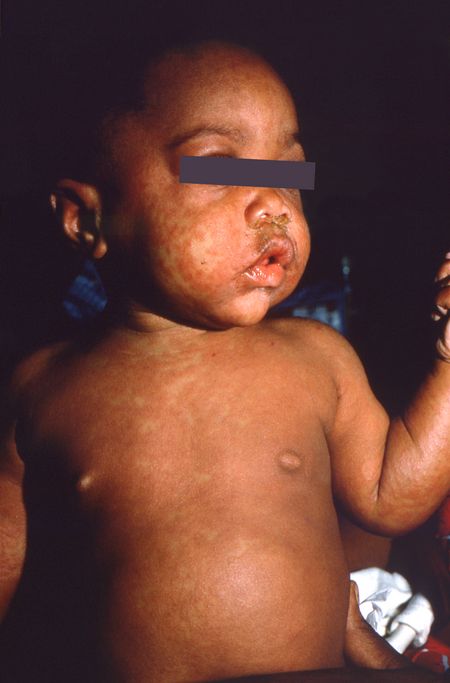
It may take 5 to 21 days (on average 10 to 14 days) between exposure to the measles virus and onset of symptoms. This is called the incubation period. A person begins to be contagious 4 days before the rash appears and can remain contagious up to 4 days after onset of the disease. Measles last 1 to 2 weeks.
As it is highly contagious, if you have symptoms of measles, call Info-Santé 811 before going to a medical clinic or emergency room.
Info-Santé professionals will give you instructions on the precautions to take before you go (for example, wear a mask). This way, you can avoid transmitting the disease to your loved ones or others.
If your state of health requires an immediate consultation, inform the medical staff before you travel to let them know that you or your child may have measles.
Measles can lead to many complications.
Treatment
There is no specific treatment against measles. Vaccination remains the best way to protect yourself against this disease.
If you have measles, you must:
- Stay home
- Avoid contact with other people
- Get plenty of rest
- Drink plenty of fluids, like water
- Take medication for fever or discomfort
Complications
Complications of measles may include:
- Ear infection (5 to 9% of cases)
- Persistent diarrhea, especially in newborns
- Pneumonia (1 to 5% of cases)
- Convulsions (the body stiffens and muscles contract in a jerky and involuntary manner)
- Loss of sight or hearing
- Permanent brain damage (1 in 1,000)
- Death (1 in 3,000)
People most at risk of complications
Complications are most common in the following:
- Babies under one year old
- People with an immune system that is weakened by treatment against another disease or by a serious illness such as leukemia
- Pregnant people who are not adequately vaccinated against measles
Pregnant people who have measles are more at risk of having a miscarriage or giving birth prematurely.
In the event of exposure to the virus, these people should contact Info-Santé 811 promptly to be evaluated and, if necessary, receive preventive treatment. The latter consists of an antibody injection to be administered within seven days of exposure.
Transmission
Measles is a contagious disease. It is possible to get infected and to catch the disease without being in direct contact with someone with the disease. For instance, it could be enough to be in the same room as a contagious person, even during a short period of time.
The virus can survive for several hours suspended in the air and can even disperse. The disease can also be transmitted through direct contact, by touching an infected person or contaminated objects.
La rougeole : une maladie contagieuse qui se propage rapidement! (In French only)
Watch the video
Disclaimer: the video player is YouTube’s and may have some accessibility barriers. You can skip to the content after the video
Disclaimer: the video player is YouTube’s and may have some accessibility barriers. You can skip to the content before the video.
Preventing transmission
Children and adults who are sick should stay home from daycare centre, school and work and avoid being in contact with young children, people with weakened immune system and pregnant people. They should stay home until four days after the rash appears.
Vaccination
Vaccination is the best way to be protected against measles.
The measles vaccine is a combined vaccine, which means that it protects against several diseases at the same time.
According to Québec’s immunization schedule, children are given the vaccine at 12 months and 18 months. The vaccine thus protects them adequately at a time when they are most at risk of catching measles. It is therefore imperative that you book an appointment as close as possible to the date on which your child turns one. Avoid postponing the measles vaccine, even if it means your child must receive several vaccines in that appointment.
Anyone born from 1970 onwards who has never received the measles vaccine or who has never had the disease should get vaccinated.
Since free vaccination was introduced in Canada, the number of cases of measles has decreased by almost 97%.
Precautions for travellers
Measles exists in many countries. Before travelling, it is advised that you have your vaccination record and that of your children checked by a doctor or nurse. To know if you are adequately protected against measles, check with a travel health clinic, a CLSC, a local point of service or call 1-877-644-4545.
Procedure for getting vaccinated
Verify if you are considered protected. Vaccination against measles is free under the Québec Immunization Program.
See the page Québec Immunization Program to know the procedure for getting vaccinated.
You can schedule an appointment on the website
Who can get measles
Anyone not protected against measles or that has not had the disease can catch it.
Special conditions
Measles is a reportable disease.
When laboratory staff and health professionals detect a case of measles, they must inform public health authorities.
Measles in the classroom: What to do
Should a school report a case of measles, and depending on how the illness evolves, non-vaccinated individuals may be asked to stay home until the outbreak has ended. Such individuals may return to school upon providing valid proof of vaccination. This measure is intended to protect the health of unprotected individuals and their communities.
See also
Last update: September 25, 2026