INRS oncology experts use liquid biopsy to investigate the quality of marine ecosystems.
LAVAL, QC, July 23, 2024 /CNW/ - How can a team of oncology specialists provide insight into the effects of climate change on marine ecosystems? This is the challenge that a team from the Institut national de la recherche scientifique (INRS) brilliantly tackled under the supervision of Professor Yves St-Pierre and doctoral student Sophia Ferchiou, applying the principles of liquid biopsy—a technique used in early cancer detection—to the mussels of Quebec.
Medicine on call for biodiversity
By their very nature, mussels act as filters within their environment. As such, they are excellent bioindicators for assessing marine ecosystems. The research team therefore applied principles of liquid biopsy to the mollusks in order to investigate their ecosystem.
In humans, liquid biopsy involves analyzing DNA circulating in the bloodstream for evidence of cancer. It provides valuable indications of the type of cancer the patient has, the stage to which it has progressed, and the mutations generated by the disease. Since mussels retain traces of everything that enters their environment, liquid biopsy can provide significant insight into the ecological situation.
"The innovation lies in the use of new technology, i.e., multi-omic analysis, with which we can detect mutations, genetic and epigenetic changes, as well as DNA derived from organisms such as viruses, parasites, bacteria, and even certain species of fish in a given ecosystem," explained Professor Yves St-Pierre, INRS oncology specialist. The researcher, who is based at the
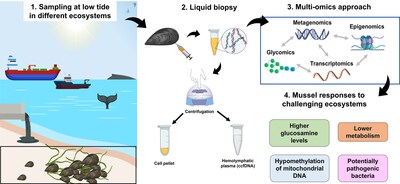
The liquid biopsy consisted of analyzing the hemolymph—a fluid analogous to blood in vertebrates—of several thousand mussels, providing a veritable treasure trove of environmental data and information.
"We are following the same course as we would with a cancer patient," Professor St-Pierre stated. "We diagnose the disease, prescribe treatment, and then follow up on developments. The sooner we can detect signs of cancer or, in this case, environmental problems, the sooner we can intervene. With liquid biopsy, we are applying the same methodology and even the same philosophy to biodiversity."
A collaborative approach rooted in fieldwork
This project is currently at the heart of the work led by doctoral student Sophia Ferchiou at INRS. "My research consists of using mussels as a sentinel species, i.e., a species highly sensitive to changes in its environment, to assess the health status of marine and coastal ecosystems," stated the marine biology student, who studies under the joint direction of Professor Yves St-Pierre and Stéphane Betoulle of the University of Reims.
The team conducts its research in close collaboration with
"By applying medical techniques to marine ecosystems, not only can we make a diagnosis, but we can also observe warning signs for future issues that are likely to affect an ecosystem. Are there traces of chemicals or signs of a viral outbreak? We can therefore apply early corrective measures, which we will monitor regularly using liquid biopsy," Sophia Ferchiou highlighted.
Initially led by the doctoral student once a month since 2019, these sample collections now take place on a weekly basis thanks to the participation of Parks Canada biologists across the different sites, providing a unique opportunity to regularly monitor the ecosystems. "This partnership has enabled us to collect an extraordinary number of samples," Sophia Ferchiou exclaimed. "Our study demonstrates the effectiveness of multi-omic analysis of liquid biopsies sampled from mussels to observe their biological response to environmental stress."
"One of our conservation team's mandates is to determine and monitor the health of the ecosystems in the Saguenay–St. Lawrence Marine Park. The approach proposed by INRS is part of a series of scientific monitoring projects carried out by our team and various partners to gain a better understanding of the changes and threats to the marine park's ecosystems. Not only is the method innovative and promising, but it is also non-invasive and relatively simple to apply in the field. We are very pleased to be able to work with the team and rely on their expertise."
About the study
The article entitled "
This research was funded by the
About INRS


 View original content to download multimedia: