- Home
- Agriculture, environment and natural resources
- Wildlife
- Living with Wildlife
- What to do when bats are found in a building
What to do when bats are found in a building
Rabies: a risk to you and your pets
Bats can carry the rabies virus, which is a deadly disease for human beings and animals. To protect yourself, never touch a bat, alive or dead, with your bare hands.
Bats are protected species. Certain measures can be taken to prevent them from getting into buildings, or to get them out if they have settled there, while protecting the species. It is also possible to preserve colonies safely.
No product or trap is registered for use against bats.
Sheltering bats safely
In summer, bats may use house attics as a colony site to raise their young. In winter, most leave attics to hibernate in caverns, caves or abandoned mines. However, some bats sometimes decide to spend the winter in attics.
If you notice several bats in your building, they may form a colony. Bats may use the building as a roost. If their presence is not a problem, it can be beneficial to maintain their roost. However, it is important to make sure they cannot access living spaces and to avoid any contact. Consult the
In Québec, a bat colony monitoring program has indeed been set up in collaboration with citizens and scientific partners.
Checking for the presence of a colony in a building
Several signs may indicate the presence of bats in dwellings, such as noises or the presence of feces. Bats do not cause damage the way some rodents do.
Preventing them from getting into a building
To prevent bats from getting into a building, take the following precautions:
- Make sure the frames and mosquito screens on doors and windows are in good condition.
- Always close doors leading to the outside and any windows that do not have a mosquito screen.
- Secure a mosquito screen over vents that must be kept open, for example, air vents.
- Inspect the outside of the building and repair any openings that allow bats to get into the walls or the attic.
To prevent bats in the attic from getting into the living spaces of a building, inspect the inside of the building and seal any holes 2 centimetres or larger.
Getting the species out of a building
When bats are in buildings, they can be removed using the exclusion method. The best time to get bats out of a building is between October and May.
During the summer, female bats are very active at night. They leave to go hunting, returning several times to feed their young left inside. At the end of the summer, mothers and their young leave their colony for their winter habitat. Fall is therefore the best time to get them out. If not, the young will be trapped, with no hope of survival, and the mothers will do everything they can to get inside.
Steps for getting bats out
1- Find out where they are getting into the building
To find the openings (2 centimetres, the size of a dime) that allow bats to get in, you have to inspect the building in summer and pay attention to the telltale signs.
- Inspect the outside surface of the building. The presence of blackish stains and feces stuck to the wall or to the edge of windows is a sign of entry points.
- Inspect the building at sunset to find the places where bats exit to go and feed. They use the same places to get in.
For more information on the method, consult the protocol
2- Block the openings, leaving some entry points open
Once the bats’ entry points have been located, the openings that the bats do not use can be sealed.
Any type of material can be used, since bats will not remove what is blocking their entrances. Instead, they will look for another opening to squeeze into the building and return to their colony.
From September to mid-October, it is time to block the entry points used by bats, keeping one or two access points open so that any bats still present can move in and out, avoiding trapping them inside.
Then install a one-way system on the last entry points left open. This system allows bats to leave the building while preventing them from getting back in. It is available from pest control firms, but you can also make one with mosquito screening or fine netting.
- Place the piece over the opening and secure the sides and top part of the mosquito screening or netting.
- Leave the bottom part open so that any bats still inside can leave the building by squeezing under the material, and to prevent those outside from getting in.
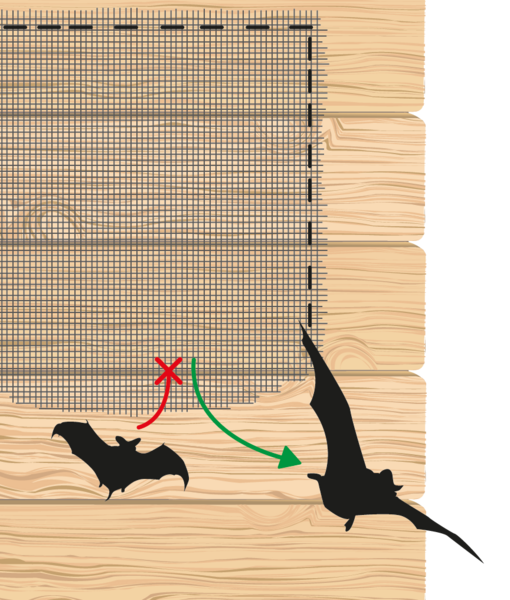
One-way system
It is best to carry out these operations during the day to limit the risk of contact with bats.
3- Seal the last openings
Between October and May, once all the bats have left, remove the one-way system and block the last access points.
To find out more about the recommendations to follow for safely removing a colony, consult the
Methods to avoid
No chemical product is registered and no trap is regulated for use against bats. Glue traps are prohibited. Furthermore, a bat that has been poisoned by a chemical product may have trouble flying and become easily approachable. The risk of contact with a human or a pet is then increased.
The following products or methods are completely ineffective:
- Mothballs (naphthalene);
- Smoke or steam;
- Light (attic lighting);
- Ultrasound;
- Essential oils.
Cleaning an environment contaminated with droppings
If bats have established their colony in your building, you will notice their droppings. Before cleaning, find out about the precautions to take and the procedures to follow for safe cleaning.
Last update: August 3, 2026