- Home
- Family and support for individuals
- Childhood and adolescence
- Child Development
- Tools and resources for child development
- Agir tôt program
Agir tôt program
About
The Agir tôt Program is intended for children under the age of 7 and their families. It makes it possible to identify signs of developmental difficulties in a child as quickly as possible in order to refer them to the right services quickly. The goal of the program is to help children develop their full potential and make starting kindergarten easier.
The Agir tôt Program’s services are free and offered on a voluntary basis. They are accessible in territorial establishments in Québec.
Early Intervention
In the first years of life, your child is in full development. They can make the most of positive experiences and interactions in their daily life to develop and thrive thanks to their brain’s great ability to reorganize and change. Early childhood is a period rich in learning, involving all areas of development.
So it is important to observe your child’s day-to-day development. As a parent, you are in a good position to detect possible signs of difficulty. Early intervention with the appropriate services will have a greater influence on your child’s development and life course.
Adults and professionals involved your child’s life play an important and complementary role too. They also monitor your child’s development on an ongoing basis in order to help identify possible signs of difficulty quickly. For example, observations can be made during a medical visit or a parent-child activity organized by a community organization.
How to request services offered by the Agir tôt Program
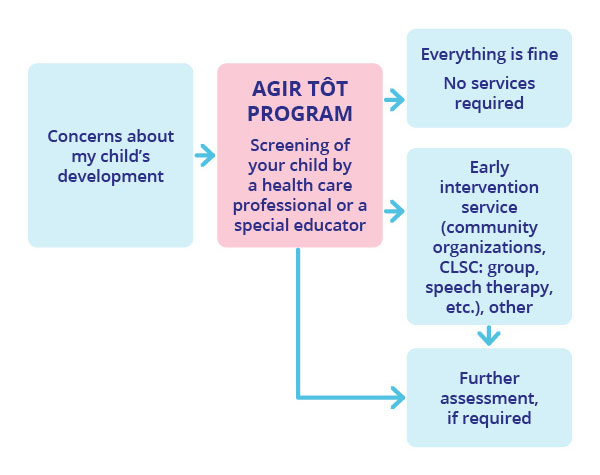
If you have concerns about your child’s development and would like more information about the program’s services, contact your CLSC. A caseworker will discuss your concerns with you and determine the appropriate service.
A doctor or caseworker who sees your child often might also ask permission to direct your child to the Agir tôt program.
ABCdaire 18 months + at the time of the 18-month vaccination appointment
One of the services available under the program is monitoring children’s development when they are given their 18-month vaccine. It is free of charge and is available at CLSCs.
During the appointment, in addition to giving your child the vaccine, the nurse can, with your agreement, complete the ABCdaire 18 months. She will ask you questions about your child’s overall health and development.
Your cooperation and observations are very important to help her complete the development monitoring tool. To prepare for the appointment, it is important to consult these two tools:
a clip that describes what will happen during the appointment and what observations the nurse will make ;a quick reference tool that will tell you what to observe before the appointment .
After the 18-month appointment, if any concerns or difficulties have been identified, you may be referred to other Agir tôt Program services or other resources, depending on your needs.
In addition to the 18-month appointment, consult this sheet “
Needs assessment and screening
When signs of difficulties or concerns are raised about your child’s development, your needs will be assessed by a professional from the Agir tôt Program. Your concerns and priorities as a family will guide the process and be central to decisions in order to identify the best services for you. Care and education providers who are close to your child and who know them well may also be involved at this stage, for example staff at daycare or school.
If it is considered necessary, you may also be referred to Agir tôt screening to help you and other care providers understand your child’s development and needs better.
Screening consists of answering questionnaires on a digital platform accessible via the Internet and speaking with a care provider. The questionnaires document several areas of your child’s day-to-day development and functioning.
Screening is available any time between your child’s birth and when they start school, if it is considered appropriate. However, it is not mandatory or done with all children referred to Agir tôt services.
Early intervention
The Agir tôt Program provides access to a variety of intervention services to help your child develop and function well in their living environments, including at home, in daycare and at school. Services are also available to support you: being a parent of a child who has developmental challenges can be demanding and sometimes stressful.
The interventions aim to:
- help and support you, as a parent, to stimulate your child in the stages of their development and support them in their daily life;
- provide comprehensive stimulation or other interventions to help your child develop and function effectively at home, in daycare, and in the community;
- collaborate with people who see your child on a daily basis, such as daycare staff, the school team, their teacher, their doctor or staff in the community organization they go to for activities;
- get your child ready to start kindergarten and ensure the transition goes smoothly;
- support you throughout the processes and services provided;
- support you in order to prevent burnout and help you cope with daily challenges.
The intervention teams are made up of professionals from various disciplines who will be attentive to your concerns and your family’s situation.
References and resources
Although each child is unique and develops at their own pace, references are available to guide you through the major stages of development and support you in your role as a parent.
Many resources are also available in your community to support you and your family. Feel free to use them!
Child development references
Stages of growth – From Tiny Tot to Toddler
Institut national de santé publique du QuébecChild development from ages 1 to 3 (in French only)
Naître et grandirChild development from ages 3 to 5 (in French only)
Naître et grandirDaily child development from 0 to 6 years (summary tables - PDF) (in French only)
Éditions du CHU Sainte-Justine- Health Promotion
Santé Québec – Centre hospitalier universitaire Sainte-Justine Books on childhood and the family
Éditions CHU Sainte-JustineVideos on the well-being and development of 0 to 8 years old (in French only)
Naître et grandirInformation sheets for parents of children aged 2 to 5
Sheets that help managing emotions, discipline, development, diet, communication and sleep
Ministère de la Santé et des Services sociauxDéveloppement de la communication chez l'enfant de 0 à 6 ans (in French only)
Information on auditory skills and language development
Ordre des orthophonistes et audiologistes du QuébecDis-moi – Le développement de l’enfant (videos) (in French only)
Videos to better understand the development of toddlers
Association québécoise des centres de la petite enfanceCaring for kids
Information on children's health given by Canadian pediatricians, in French and English
Canadian Paediatric SocietyEncyclopedia on Early Childhood Development
For parents and professionals, information on various topics, in French and English
Centre of Excellence for Early Childhood Development – Université de MontréalVideos - Encyclopedia on Early Childhood Development (in French only)
Centre of Excellence for Early Childhood Development – Université de Montréal
Resources for getting professional advice
Première ressource, aide aux ressources
514-525-2573 or 1-866-329-4223
consultation@premiereressource.com
Free professional consultations for all subjects related to the education of children aged 0 to 18 and the parent-child relationship
Available Monday to Friday, from 8 a.m. to 5 p.m., by phone, chat or emailTel-jeunes Parents
Professional support service for parents of teenagers aged 12–17
Phone : 1-800-361-5085
Chat :https://teljeunes.com/en/parents
7 days a week
Available in French and in English- Info-Santé 811
811
Health advice given by a nurse
24 hours a day, 7 days a week
Available in French and in English - Info-Social 811
811
Psychosocial advice given by a psychosocial worker
24 hours a day, 7 days a week
Available in French and in English
Directories for finding community resources
211
Multilingual service that lists and directs to socio-community resources in the regions of QuebecFédération québécoise des organismes communautaires Famille (FQOCF) (in French only)
Directory to find family community organizations in the regions of Quebec
Last update: February 12, 2026