- Home
- Housing and Territory
- Healthy living environment
- Air quality
- Residential radon
Residential radon
Radon is a radioactive gas that comes from uranium that occurs naturally in the Earth’s crust. It is found in soil, everywhere on the surface of the Earth. The amount of radon in the soil can vary widely from place to place. Radon can also be found in groundwater.
Radon can get into buildings, especially through foundations, but also, in some cases, through well water. It can accumulate indoors and reach concentrations that can pose a health risk. Since it is a colourless, odourless and tasteless gas, it is impossible to detect.
Health effects
Radon enters the lungs with the air we breathe. Major organizations and international health agencies have recognized it as a carcinogen. It gives off radioactive radiation that can, in the long term, cause lung cancer.
Radon is the second leading cause of lung cancer, after smoking. It is also the leading cause of cancer in people who don't smoke. In Canada, 16% of lung cancer deaths are associated with radon. In Québec, it accounts for more than 1,000 deaths per year. Of these deaths:
- 60% occur in people who smoke;
- 30% in people who have quit smoking;
- 10% in people who do not smoke.
The risk of radon‑induced lung cancer increases with:
- the concentration of radon: the more a person is exposed to high levels of radon, the higher their risk of cancer;
- the duration of exposure to radon: the risk of cancer is higher if a person is exposed to the gas over several decades. Exposure at a young age also amplifies the effect;
- smoking: smokers who are exposed to radon have a higher risk of developing lung cancer than non‑smokers.
Radon does not cause:
- respiratory disorders, such as chronic bronchitis and emphysema;
- allergies;
- asthma;
- congenital malformations.
Identifying sources of radon in a building
Radon is diluted quickly in the outdoor air. So radon levels are generally very low outdoors. Because of this, it does not cause health problems.
However, radon can get into the indoor air of buildings, through different openings:
- dirt floors;
- cracks in the concrete slab or foundation walls;
- sumps;
- crawl spaces;
- joints;
- openings around exhaust ducts and service connections, for example pipe fittings;
- radon-rich groundwater supplies can also be a route of entry into homes.
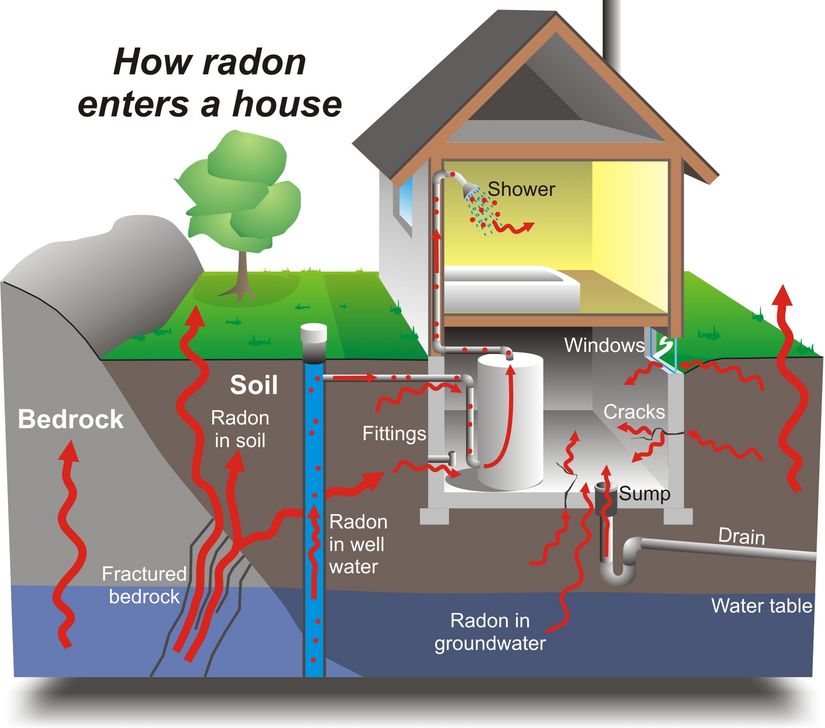
Source:
Radon mainly builds up in the lowest and least ventilated rooms of a building, for example in the basement. The concentration of radon in the indoor air of a home can depend on several factors:
- the concentration of uranium and radon in the soil;
- climate;
- ventilation of the premises;
- how well sealed the house is;
- the floor of the house (the concentration is usually higher on the lower floors);
- negative pressure, i.e., the fact that the air pressure is lower inside the building than outside. This creates a vacuum. Radon can then seep through cracks and other points of contact with the ground.
Since the radon concentration depends on the configuration of the building, it is recommended that new measurements be taken after major changes to the envelope (e.g., insulation) or foundations.
Measuring the radon concentration in a home
To find out the radon concentration in your home, you need to measure it using a device called a radon monitor, which gives the concentration in becquerels per cubic metre of air (Bq/m³). It is recommended that you place it in the basement about one metre from the floor, or on the first floor if the basement is not occupied.
Do not rely on test results from a house next to yours or other homes in your neighbourhood. The radon concentration can vary a lot between homes that are close to each other due to the characteristics of the soil and the building. The concentration may also vary between apartments in the same building because of the configuration of the building.
There are two types of monitors: passive and electronic.
Passive monitor
A passive monitor must be left in place for at least three months and preferably in winter (October to April). Outside this period, tests indicating less than 200 Bq/m2 must be repeated in winter. Once the measurement has been done, the monitor must be sent to a specialized laboratory for the measurement to be read.
To measure the radon concentration in your home yourself, you must buy a monitor and use it in accordance with the manufacturer’s instructions. A passive monitor costs around $50, including the analysis. It is non‑reusable.
Electronic monitor
An electronic monitor offers the possibility of providing immediate measurements, often in a day. However, it is generally less accurate than a passive monitor. It is recommended to measure the radon concentration for at least one month, and ideally three months in winter (October to April).If the concentration exceeds 100 Bq/m3 (after one month), the measurement must be extended over at least three months or the result must be validated with a passive monitor. An electronic monitor is reusable for several years and can be used in more than one home if reset each time.
Outside this period, only results exceeding 200 Bq/m² can be considered significant.
Getting a monitor
To buy a monitor, you can:
- order a passive monitor on the site of the
Association pulmonaire du Québec (in French only), which sells monitors that are certified and approved by Health Canada; - go the
CAA Québec Habitation site, which provides information on how to buy a monitor; - buy a kit to test for radon in the air. They are sold in some hardware stores.
The
Libraries in some municipalities have an electronic radon monitor lending service.
You will find a list of recommended electronic monitors on the
To obtain a list of certified radon measurement professionals who work in Québec, use the
Measures to take if the radon concentration exceeds the Canadian guideline
In general, the radon concentration is not very high in homes in Québec. The average concentration of radon in basements is around 37 Bq/m³. However, concentrations can sometimes reach very high levels, up to more than 1,000 Bq/m³.
In Canada, there is a guideline stating that the maximum acceptable radon concentration in a home is 200 Bq/m³. If the concentration in your home exceeds this limit, you should take corrective measures within one year.
Personal protective measure
If you smoke, the first thing you need to do to protect yourself from radon‑induced lung cancer is stop smoking. This is the fastest and cheapest way to lower the risk of radon‑induced lung cancer. Indeed, a person who is exposed to both tobacco smoke and radon greatly increases this risk.
For a person who smokes, exposure to radon levels above 800 Bq/m³ can double the risk of lung cancer.
Corrective measures for your home
You will get better results by applying more than one corrective measure. For example, you can:
- seal cracks in the foundation;
- seal openings in contact with the ground;
- make sure that sumps are covered and ventilated to the outside;
- improve the ventilation of your house, especially in the basement;
- open windows when the outside temperature allows.
If the radon concentration in your home is very high, these measures may not be enough. In this case, you will need to hire a qualified contractor. They will install a system that evacuates the radon under the foundations before it enters the living spaces of the building.
Health Canada recommends that people who take corrective measures try to reduce the radon concentration to the lowest possible level. This is why it is recommended to measure it again after applying corrective methods, in order to verify their effectiveness.
Several specialized companies that can help you reduce the concentration and entry of radon into your home. It is very important to do business with a certified company. You will find a list of certified companies on Health Canada’s
Measures for new buildings
When building a new house, you can ask your contractor to use mitigation techniques to minimize the amount of radon entering the house. If necessary, these techniques can also be applied to facilitate the evacuation of radon once the house is built. However, it is simpler and cheaper to do so at the start of construction.
Last update: October 31, 2024