

Your vehicle must be winter-ready from December 1 to March 15. However, because spring conditions can be variable, it is recommended that you wait until a few weeks after the end of this period to install your all-season or summer tires.
The requirement applies to all motor vehicles registered in Québec, including rental vehicles. However, this requirement does not apply to trailers and vehicles registered outside of Québec. Drivers who do not comply are liable to a fine of $200 to $300.
Exceptions
The winter tire requirement does not apply for:
- Trailers
- Vehicles registered outside of Québec
- Heavy vehicles
- Utility vehicles
- Farm machinery
- Spare tires
- Motorcycles used as emergency vehicles
- A period of seven days from the date the vehicle was acquired from a dealer (you must be in possession of the bill of sale for the vehicle or a copy thereof)
- The seven days prior to expiry of the vehicle’s lease agreement when the term is one year or more (you must be in possession of the lease agreement or a copy thereof)
- Vehicles with a
dealer plate (X licence plate) - Vehicles with a
temporary certificate of registration (transit) for the period of validity set out in the certificate, but not more than seven days after the certificate issue date - Motor homes, specifically motor vehicles permanently used as homes (e.g., recreational vehicles)
Winter tire exemption certificate
The Société de l’assurance automobile du Québec (SAAQ) may issue a seven-day winter tire exemption certificate. To obtain an exemption certificate, make a request through
Winter tire compliance
To be compliant, a tire designed for winter driving must be marked with the pictogram illustrated below or be studded. Tires that are reshaped or remodelled for passenger vehicles must also have the pictogram or be studded.
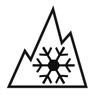
Studded tires
Studded tires are permitted from October 15 to May 1 on commercial vehicles whose total loaded mass does not exceed 3,000 kg, passenger vehicles, and taxis.
Checking tire condition
Winter tires are designed to prevent snow from accumulating in their grooves. Deeper grooves mean:
- Better traction in the snow
- Faster snow and slush clearance
- Reduced braking distances
- Safe acceleration
The grooves on your tires should not be less than 1.6 mm deep. During the winter, the recommended depth is at least 4.8 mm. To measure the depth, place a quarter in a groove with the caribou’s nose pointing down. If you can see the caribou’s snout, this means the tire will not grip well in deep snow. Check several grooves in different locations for tire wear.
See the following capsule from CAA-Québec:
Winter tires in good condition make it possible to:
- Reduce braking distance by 25%
- Maintain tire elasticity to -40°C
However, winter tires and their condition are no guarantee against accidents. Adjust your driving to weather and road conditions:
- Slow down
- Stay further away from other vehicles
Avoiding winter tires in the summer
Winter tires should not be used in the summer for several reasons, including increased safety risks.
- The rubber in winter tires wears down more quickly in warmer temperatures, increasing the risk of tires bursting and potentially causing a loss of vehicle control.
- Winter tires do not evacuate water as efficiently as summer or all-season tires, decreasing aquaplaning resistance.
- The stopping distance for winter tires used in the summer may be greater than that of all-season tires, especially on wet pavement.
Last update: July 13, 2026