- Home
- Agriculture, environment and natural resources
- Animal health, security and welfare
- Animal diseases
- List of animal diseases
- Black spot disease in fish
Black spot disease in fish
Description
Black spot disease is caused by the encystment Read the content of the note 1 of certain species of flatworms, known as “digenean trematodes”.
Wild animals at risk
To develop, digenean trematodes need to parasitize many organisms called “hosts”.
Small molluscs and fish
The first host is a small mollusc belonging to the gastropod class, such as the snail. The second host is a fish. Many species of fish can be parasitized by digenean trematodes, including yellow perch, bass, pumpskinseed, and pike.
Piscivorous birds
To complete their life cycle, digenean trematodes need a definitive host, such as a piscivorous bird like the great blue heron, belted kingfisher, gull, or common loon.
Signs of the disease
Digenean trematode cysts are responsible for the spots on fish skin, fins and organs. These spots are usually black, but can also be white or yellow, depending on the parasite species. Yellow and white spots are caused by the parasite itself, while the black spots results from the host fish’s immune response to the infection. The number of cysts may vary according to the intensity of the infection.
Black spot disease is easily distinguished from other diseases affecting wild fish. White and yellow spots can sometimes be confused with other types of parasites, such as worms of the genus Diphyllobothrium spp., especially when they appear as cysts in fish flesh.
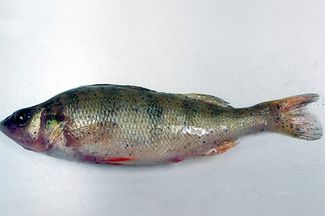
Yellow perch affected by black spot disease. © Ministère de l’Environnement, de la Lutte contre les changements climatiques, de la Faune et des Parcs
Life cycle and persistence in the environment
In their adult state, these flatworms are found in the digestive system of piscivorous birds. Measuring between 1 and 5 mm, they reproduce in the bird’s intestines and produce eggs. These are eliminated in the bird’s excrement, contaminating the aquatic environment. In water, the eggs release larvae that penetrate their first host, usually a snail. The larvae evolve into cercariae in this host. The cercariae then leave the mollusc and infect their second host, a fish, by passing through its skin. In fish, the larvae develop into metacercariae, encysting in the skin, gills, fins or viscera. The cycle ends when the infected fish is eaten by a piscivorous bird, allowing the parasites to become adults capable of reproduction.
The presence of parasites in a fish depends on the presence of all the hosts required for its life cycle, from egg to adult. Metacercariae can survive for several years in fish.
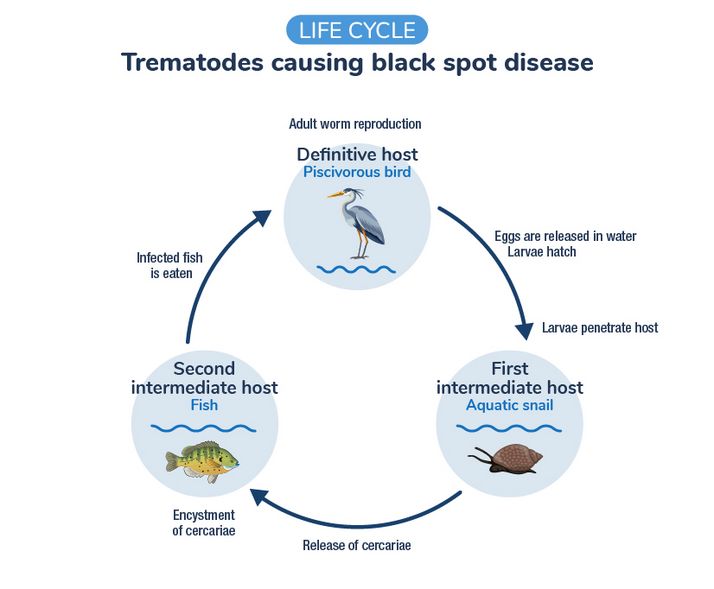
Life cycle of digenean trematodes. © Ministère de l’Environnement, de la Lutte contre les changements climatiques, de la Faune et des Parcs, Ariane Côté
Protection and prevention
Risk to wildlife health
Parasitic cysts do little harm to the host fish, unless they affect the scales or the functions of a vital organ such as the gills. However, heavy infestation can be damaging, even fatal, for juvenile fish. According to a recent study, fish tolerance to these parasites is reduced in polluted environments. Black spot disease is difficult to control in wild fish.
Risk to pet health
Transmission of this type of parasite to pets has been documented. As a precaution, we advise against feeding raw (or undercooked) fish parts or viscera to pets.
Risk to human health
Several species of parasites can cause black spot disease. Some are known to be transmissible to humans elsewhere in the world, such as Chinese fluke or yellow grub in Asia. These parasites are not visible to the naked eye, and their presence in Québec is not well documented. As a precautionary measure, we consider that a risk of transmission to humans is possible. Humans can become infected by eating raw or undercooked fish, which can cause digestive problems. Cooking the fish kills the larvae and allows safe consumption of fish. To avoid contamination, it is important to learn about consumption of wild fish.
Monitoring and control
It is well known that black spot disease is present in Québec, so there is no need to report suspect fish. To prevent the parasite from developing fully, unused fish parts should be disposed of in the garbage or burned, not thrown back into the water.
-
Footer note number 1Formation of a layer of dense connective tissue around a foreign body (or tumour), isolating it from the surrounding tissue. Back to the reference of the note 1
Last update: November 18, 2024