- Home
- Agriculture, environment and natural resources
- Animal health, security and welfare
- Animal diseases
- List of animal diseases
- Blotchy bass syndrome
Blotchy bass syndrome
Description
Blotchy bass syndrome is characterized by the appearance of irregular dark blotches on the body, fins or mouth of infected fish. It is caused by different viruses of the adomavirus family, which vary according to the species infected.
Wild animals at risk
Adomaviruses have been detected in smallmouth bass and largemouth bass with dark blotches on the body surface, known as hyperpigmented melanistic lesions (HPMLs). However, it has not yet been proven that these viruses are the cause of the syndrome. Cases of HPML have also been reported in other freshwater species, notably sunfish and brown bullhead.
Signs of the disease
Fish affected by the syndrome have skin lesions in the form of smooth, irregular black or dark brown blotches on the skin, fins and mouth. These lesions may be slightly bulging, although their size, shape, location and number vary considerably, with some measuring as little as 2 mm, and others covering the entire body of the fish. The causes of these variations are remained unknown. This melanistic hyperpigmentation is the result of an immune reaction in infected fish. Some may have no symptoms at all. When a syndrome is present, it mainly affects adult fish, with a notable visibility in bass usually over 17.5 cm long.
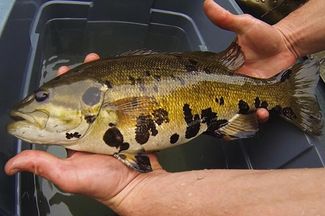
Bass with blotchy bass syndrome. © United States Geological Survey, Megan Schall
Life cycle and persistence in the environment
Further studies are needed to understand the life cycle and modes of transmission and infection of adomaviruses possibly associated with blotchy bass syndrome.
Cases reported by fishermen occur mainly in colder waters. The number of cases seems to be higher in the colder months, from late fall to early spring, than in the warmer summer months.
Protection and prevention
Risk to wildlife health
The exact impact on infected fish is not yet known. Wild animals other than fish are not affected by this syndrome.
Risk to pet health
The virus poses no risk to pets.
Risk to human health
The virus does not pose a danger for humans.
Monitoring and control
The virus is known to be present in Québec, so there is no need to report suspect fish.
Last update: November 18, 2024