- Home
- Agriculture, environment and natural resources
- Animal health, security and welfare
- Animal diseases
- List of animal diseases
- Fish lice
Fish lice
Description
Fish lice are small parasitic crustaceans that can be found on the skin, gills, fins and mouth of freshwater and saltwater fish.
Wild animals at risk
Fish lice mainly infect freshwater fish, although a quarter of all infections occur in saltwater fish. The disease affects various types of fish, particularly those living in warmer waters. Amphibians are also susceptible to the disease.
Signs of the disease
Normally visible to the naked eye, these parasites can measure up to 30 mm and have a flattened body. Fish may show bruising, lesions and localized inflammation (red areas of varying size on the skin). If the parasite lodges in the gills, these may be damaged.
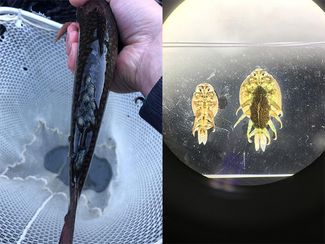
Fish infected with fish lice. @ Ministère de l’Environnement, de la Lutte contre les changements climatiques, de la Faune et des Parcs
Life cycle and persistence in the environment
Lice are transmitted to fish through direct contact. Larvae, juveniles and adults can swim to the host fish. Most fish lice species are tolerant of a wide range of temperatures, from 3–4 ℃ to 30 ℃. They are most abundant in the warmer months, from late summer to early fall.
Several factors contribute to the spread of fish lice:
- Natural movement of water and fish;
- Transfer of infected fish (e.g., bait fish, stocking, introduction of a species into a new body of water);
- Transfer of contaminated water (e.g., ballast water Read the content of the note 1 , fish transport water).
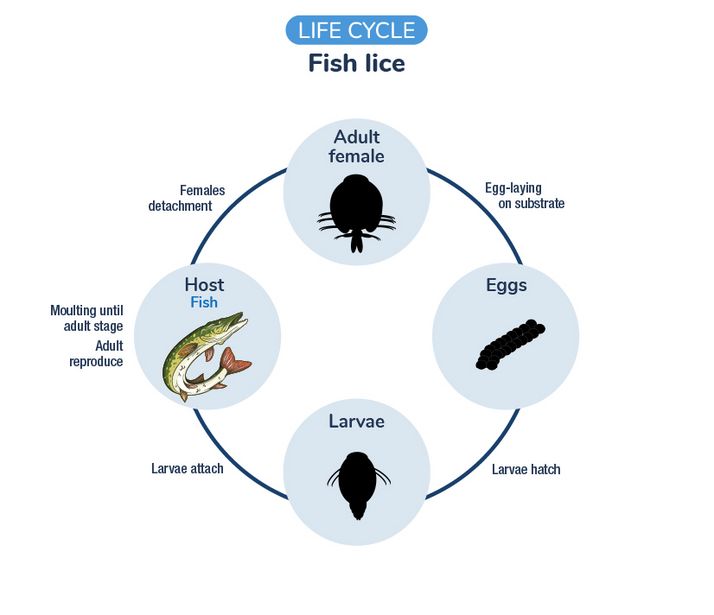
Fish lice life cycle. © Ministère de l’Environnement, de la Lutte contre les changements climatiques, de la Faune et des Parcs, Ariane Côté
Protection and prevention
To prevent contamination of water bodies, it’s important not to transport fish from one body of water to another, and not to discard fish waste in the water. Boats and equipment should also be cleaned thoroughly before and after visiting a new body of water.
Risk to wildlife health
Fish lice rarely cause serious side effects in infected fish. Often, it’s the secondary infections (bacteria or fungi) that develop on the lesions caused by the fish lice that can lead to serious consequences, even causing the death of the fish. In cases of heavy infestation, such as in aquaculture facilities where these parasites multiply rapidly, high fish mortality rates may be observed. Fish lice can act as vectors for nematodes Read the content of the note 2 and viruses.
Risk to pet health
Fish lice pose no risk to pets. They can be found on fish in aquariums and artificial ponds.
Risk to human health
The parasite does not pose a danger to humans. Fish lice can be manually removed from the infected fish before cooking. It is always important that we take the usual precautions prior to consumption of wild fish.
Monitoring and control
It is well known that fish lice are present in Québec, so there is no need to report suspect fish.
-
Footer note number 1Water contained in large tanks to correct the boat’s trim and balance. Back to the reference of the note 1
-
Footer note number 2Roundworms that can parasitize animals and plants. Back to the reference of the note 2
Last update: November 18, 2024