- Home
- Agriculture, environment and natural resources
- Animal health, security and welfare
- Animal diseases
- List of animal diseases
- Whirling disease
Whirling disease
Description
Whirling disease is a fatal infectious disease that affects juvenile finfish in the salmonid family (salmon and trout). It is caused by a freshwater parasite, Myxobolus cerebralis. This parasite needs two hosts to complete its life cycle. The definitive (i.e. final) host is a freshwater Tubifex tubifex or sludge worm. The intermediate host must be a fish from the Salmonidae family.
Wild animals at risk
In Québec, the species vulnerable to this disease are:
- Cutthroat trout
- Coho salmon
- Rainbow trout
- Sockeye salmon
- Chinook salmon
- Atlantic salmon
- Brown trout
- Brook trout
Signs of the disease
Fish that have been infected with whirling disease may show symptoms such as:
- Spinal deformity
- Skull deformity (shortening of mandible, indentations on top of head)
- Dark or black colour in the tail
- Swimming in circles (whirling)
Some infected fish, however, may not exhibit any signs of the disease.
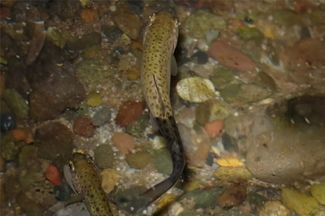
Black tails in young salmonids. © S. Hallet/OSU
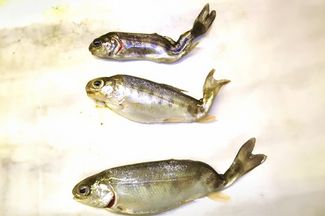
Skeletal deformities in young salmonids. © S. Hallet/OSU
Life cycle and persistence in the environment
Whirling disease is not transmitted directly from one fish to another. The parasite moves around freely and infects the fish. The disease can also be transmitted when a salmonid fish eats an infected tubifex worm. The parasite’s spores Read the content of the note 1 are highly resistant and can survive for several years in damp conditions. They can withstand freezing at –20°C and can remain viable in mud at 13°C for several months. Spores can also survive in the digestive systems of various animals. They can even attach themselves to equipment used for swimming, fishing and water sports.
Humans may spread whirling disease by transporting:
- infected fish, whether living or dead
- infected worms
- contaminated equipment
- contaminated water
- contaminated sediments (earth or mud)
- contaminated aquatic plants
The parasite can also be spread naturally through the movement of fish and water into new environments. Animals that consume contaminated fish or water may transport the parasite into another environment by displacing the fish or releasing spores in their feces.
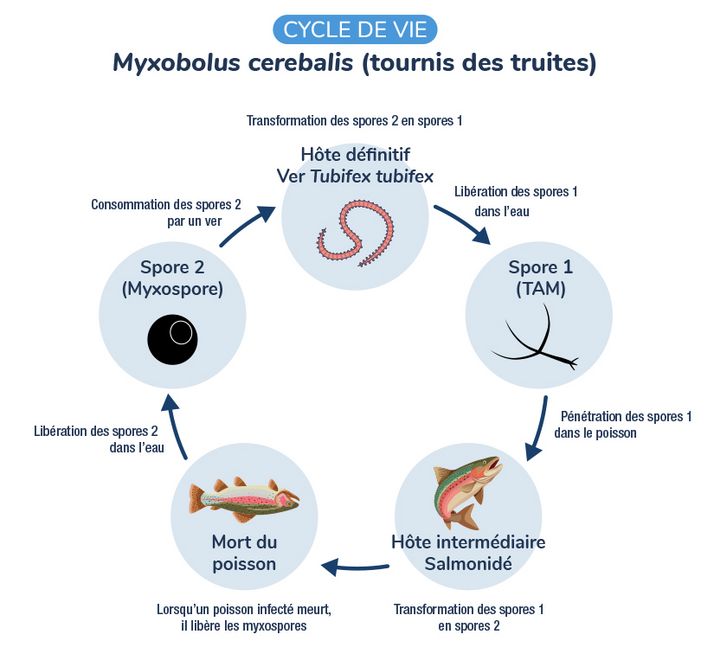
Life cycle of the parasite that causes whirling disease @ Ministère de l’Environnement, de la Lutte contre les changements climatiques, de la Faune et des Parcs
Protection and prevention
Québec’s waterways are ideal breeding grounds for the parasite responsible for whirling disease. Here are some steps for preventing the introduction and spread of this disease:
- Do not move living or dead fish from one body of water to another.
- Dispose of fish carcasses and unused baitfish in the garbage.
- Clean, empty and dry all boats and equipment that have been in contact with waterways or their banks.
To facilitate cleaning and drying, we recommend avoiding the use of equipment that does not dry easily, such as wooden oars and fishing waders.
Risk to the health of wild animals
The disease only affects salmonids, mainly fish less than a year old, with mortality rates of up to 90% in some species. The parasite can also infect adult fish throughout their lives and cause their death. The disease can severely deplete wild salmonid populations, including the endangered cutthroat trout. The risk that a fish may die from whirling disease depends on several factors, such as the presence of hosts, the intensity of infection, and environmental conditions favourable to parasite development.
Health risk for pets
Whirling disease poses no danger to domestic animals.
Risk to human health
Whirling disease does not pose a danger for humans. There is no risk in swimming or eating fish caught in infected waters. It is always important that we take the usual precautions before consuming wild fish .
Treatment
There is no cure for this disease.
Monitoring and control
To date, no cases of whirling disease have been detected in Québec. The disease was confirmed to be present in Alberta in 2016 and in British Columbia in 2024.
In Canada, whirling disease is an officially reportable disease. Any person who suspects or detects this infection is required by law to notify the
In your email report to the MELCCFP, you must include photos from multiple angles and the following information:
- date, time and place of observation;
- fish species;
- number of fish suspected of being infected.
It is important not to kill the suspected fish.
-
Footer note number 1Corresponds to a stage in the life cycle of the parasite. Back to the reference of the note 1
Last update: August 29, 2025