- Home
- Family and support for individuals
- Pregnancy and parenthood
- Adoption
- Search for information on the family of origin or on the child in adoption
- Direct-to-consumer DNA test kits: getting answers about your ancestry, medical history, and biological relatives
Direct-to-consumer DNA test kits: getting answers about your ancestry, medical history, and biological relatives
What is DNA testing?
DNA testing “reads” a person’s DNA to identify certain genetic variants. Some of these are common, while others can be very rare.
Many genetic variants are benign, determining things like your hair or eye colour. Others are more serious and can have major consequences on your health, causing hereditary diseases or cancers.
DNA contains the code that makes all life possible. It is made up of sequences that we call genes, which provide instructions for all the processes that allow living things to grow, heal, reproduce, and otherwise function normally. Humans have over 20,000 genes, which are grouped into chromosomes and found in the nucleus of every cell of the body.
If you compared two people’s genomes - the entirety of their DNA - they would be 99.9% identical. But of course, that doesn’t mean we’re all the same. Everything that makes us individuals comes from that 0.1% difference. And because everyone inherits half the genetic material of each biological parent, the differences between the genomes of two related individuals are even smaller than 0.1%.
Direct-to-consumer DNA test market
Direct-to-consumer DNA test kits can be bought online without a prescription. The customer receives a small kit and uses it to send saliva or cheek swab sample back to the genetic testing company to be analyzed in a private laboratory. They can then log into the company’s web portal to see their results.
There are few regulations governing these tests worldwide, and the market was worth an estimated US$2.02 billion in 2023. With an average annual growth rate of 17%, that value is set to reach US$6.15 billion by 2030.
Protection of personal information
Each company has its own privacy policy. Generally speaking:
- Your personal information will not be shared with insurance companies, employers, or public databases without your consent.
- If you do consent, your information will be used by the company to improve their services.
- Some companies sell the anonymized genetic data of consenting customers to pharmaceutical companies for research and development purposes.
- If the company receives a court order, subpoena, or search warrant, it may be required to share your information with law enforcement agencies.
More information on privacy and direct-to-consumer DNA testing is available online from the
Direct-to-consumer DNA testing can tell you about where your ancestors were from
Anestry tests use algorithms to analyze multiple sequences in your DNA and determine where your ancestors came from. Take the results with a grain of salt, as your results may vary depending on which algorithms are used and how in-depth they are. This means that you might get different results from different tests, even though your DNA doesn’t change!
Moreover, if one of your ethnic groups is under-represented in the company’s database, the algorithm will not be able to produce the information you’re looking for. However, as databases grow over time, it is possible that you’ll be able to get more accurate results in a few years for the same DNA sample.
Direct-to-consumer DNA testing can tell you about who you’re related to
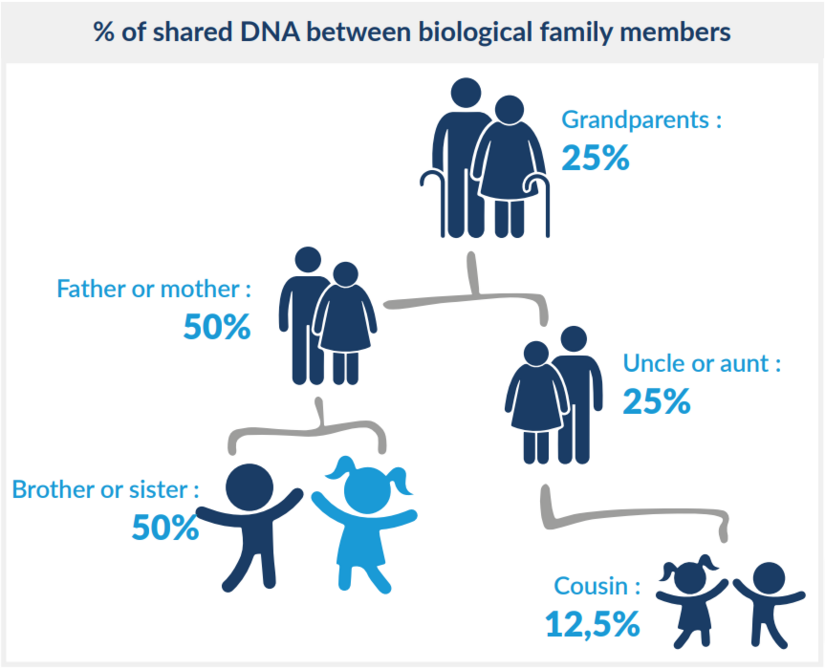
Family relationship tests analyze the DNA of two people to find out how similar their genes are. Remember, everyone inherits half the genetic material of each biological parent. This means you share 50% of your DNA with your parents and 25% with your grandparents, half-siblings, and aunts and uncles.
There are different ways to compare two people’s DNA, and the results can be expressed either as a percentage of DNA hared, as the number of matching DNA segments, or in centimorgans (cM).
Did you know?
Some companies offer messaging services so that customers can contact each other. However, keep in mind that:
- Some people may take the test just for fun and never log onto the website again. They wouldn’t see the messages if you tried to contact them.
- If you were adopted, it may have been kept secret from members of your biological family.
- If no one in your extended biological family has taken a test from the same company as you, you will not have any matches in their database.
- Companies do not share databases or communicate with each other. So, if you’re trying to find biological relatives, it might be a good idea to try with a few different companies to increase your chances.
- You can also transfer your genetic data to other internet platforms to widen your search. If you choose to do this, always stay very cautious about privacy and confidentiality.
Before you get in touch with anyone based on the results of a direct-to-consumer DNA test, you should contact child and youth protection services in the region where the adoption took place or the Québec government’s Secrétariat aux services internationaux à l’enfant (SASIE) to make sure you are not legally barred from contacting that person. These organizations also have trained professionals who can help you navigate the process of reuniting with family members.
Your health
Direct-to-consumer DNA tests can assess your risk of developing certain diseases, such as breast or colon cancer, Parkinson’s or Alzheimer’s diseases. However, they often provide an incomplete analysis, as they target a limited number of genes and mutations associated with these diseases. Direct-to-consumer DNA tests are not a substitute for medical care. If you’re worried about your results, talk to a doctor. Any genetic variant identified through a direct-to-consumer test must be verified by a medical grade laboratory.
Medical grade genetic tests
Direct-to-consumer DNA tests are not approved for medical purposes, such as adjusting medication or diagnosing an illness. For those purposes, you’ll need to get a medical grade genetic test (also called “clinical genetic test”) from qualified health professionals.
Medical grade genetic tests can be used to characterize tumors and diagnose hereditary diseases in you or your siblings, among other things. These tests must be prescribed by a healthcare professional and are available online and through specialized public and private clinics. See the
Genetic counselling
Genetic counselling can help patients and their families understand and cope with the effects that genetic diseases can have on their mental and physical health.
It is provided by genetic counsellors, professionals with master’s degrees who are trained in both medical genetics and mental health support. They can talk to you about the ethical, legal, and social implications of genetic diseases.
Genetic counsellors in the public and private sector work closely with other healthcare professionals to thoroughly understand clinical genetic analyses and provide their clients with appropriate care.
See also
Last update: December 13, 2024