

Population et territoire
Odanak and Wôlinak, the two Wabanaki communities in Québec, are located on the south shore of the St. Lawrence River near Trois-Rivières, between Sorel and Bécancour. There are more than 3,705 Abenaki in Québec, at least 411of whom live in Odanak and Wôlinak. Hundreds of Abenaki live outside their community, all over North America.
Explore the
![[Translate to Anglais:] Carte représentant le positionnement des communautés Abénaquis](https://cdn-contenu.quebec.ca/_processed_/2/c/csm_Carte_Abenaquis_Abenakis_ae505dfee2.png)
Watch the videos.
Disclaimer: the video player is YouTube’s and may have some accessibility barriers. You can skip to the content after the video
Disclaimer: the video player is YouTube’s and may have some accessibility barriers. You can skip to the content before the video.
Language
The Abenaki belong to the Algonquin linguistic and cultural family. In Québec, they speak French, and many also know English. The Abenaki language (Aln8ba8dwaw8gan) Read the content of the note 1 is still spoken by some elders.
History
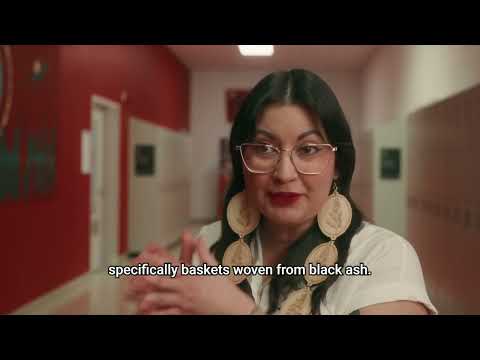
Ash and sweetgrass basketry have long been a major source of income for the Abenaki Nation. Every summer, Abenaki families would travel to the United States to sell their baskets, which they made during the winter. Then, in the early 20th century, merchants from Montréal, Toronto and New York City began coming to Odanak to buy products from the Abenaki and sell them raw materials. Abenaki families subsequently stopped taking summer trips to the United States.
Economy
Many cultural organizations are dedicated to the protection and dissemination of Abenaki culture. Since 1960, the Société historique d’Odanak has overseen the Musée des Abénakis, one of the largest Indigineous museums in Québec. In addition, a group called Alnôbaiwi holds cultural and community activities that bring together Indigineous and non-Indigenous peoples. Mikwôbait, a dance troupe, also performs in Québec and abroad.
The Abenaki of Wôlinak have a pine plantation and a number of small and medium-sized businesses, including a seniors’ residence, a fibreglass product plant and a garbage and recycling collection company. In 1999, the Abenaki Council of Wôlinak established Carrefour Wôlinak, a business incubator that provides assistance to both Indigineous and non-Indigenous small businesses. Odanak is now home to the Kiuna Institution, the first college dedicated to educating Indigineous peoples in Québec.
KWAI!
The Abenaki, people of the rising sun, watch over the Saint-François River, or ALSIG8TEGW in the Abenaki language. Their culture, closely tied to their territory, is deeply connected to nature and to the black ash tree.
Their language, once considered extinct, is undergoing a renaissance which marks the Abenaki people's reconnection with their identity.
Legend has it that the first men and women carved from ash trees began to sing and dance as soon as they touched the earth. That's why the Abenaki continue to sing and dance, perpetuating their culture.
They invite all Quebecers to come and meet them so that they can discover their rich cultural heritage. It's by forging links that we can help keep this heritage alive for future generations.
-
Footer note number 1Each Indigenous nation has its ancestral language, which may be divided into several dialects. Furthermore, the names of ancestral Indigenous languages are drawn from the the
document regarding bill 96 , presented by the Assembly of First Nations Quebec-Labrador on September 28, 2021. Back to the reference of the note 1
Last update: May 22, 2025