- Home
- Transports
- Traffic and road safety
- Traffic rules and tips for various modes of transportation
- Bicycles and electric bikes
- Bikeways
Rules for using a bikeway
A bikeway is a lane designed for the exclusive use of cyclists or for shared use with other means of travel.
Bike paths and multi-use paths
Bike paths are located away from any traffic lanes or separated from them by a physical barrier. Generally, multi-use paths have wider lanes to facilitate sharing with other types of users.
Bike paths are reserved for cyclists only, while multi-use paths may be open to other users such as pedestrians and rollerbladers.
Municipalities are responsible for bike paths and multi-use paths located outside the public right-of-way (e.g., former railway rights-of-way). The Highway Safety Code therefore does not apply to them. Municipalities can set specific rules, such as the type of users who can use them, the direction of traffic, the speed limit and the applicable fines. For example, on certain bike paths or multi-use paths, it is permitted to walk, ride a four-wheel scooter or ride an electric scooter. Check the municipality’s website for the rules governing its bike paths.
Intersection of a bike path or multi-use path and a roadway
When a bike path or multi-use path crosses a roadway, cyclists do not have the right of way. They must obey the posted signs.
If they encounter a stop sign, they must stop and yield to other road users traveling on the roadway before proceeding.
If they arrive at a pedestrian traffic light with a red light, cyclists may proceed after coming to a complete stop. They must then ride at a reasonable and safe speed and yield to pedestrians.
Bike lanes
Bike lanes are located along the roadway, without any physical barrier. Bollards may be installed to create a barrier between vehicles and cyclists.
Bike lanes are generally found on roads where the speed limit is 50 km/h or less and are located to the right of other traffic lanes.
They are always one-way. Cyclists generally ride in the same direction as road vehicles. However, on some one-way streets, the bike lane may be in the opposite direction. In this case, the diamond on the traffic sign has a red background.
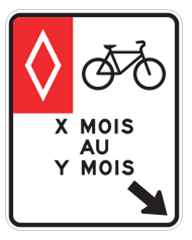
Sign indicating the presence of a bike lane reserved for cyclists for a specified period of time
Pedestrians are not allowed to walk on the bike lane. They must walk on the sidewalk, if there is one, on the edge of the roadway, or on the shoulder in the opposite direction of traffic. See the rules and safety tips for pedestrians.
Designated roadways
A designated roadway is a road shared by bicycles and vehicles. It uses a simplified signage and there is no dedicated bike lane. When riding your bicycle on a designated roadway, you must follow the same traffic rules as on the rest of the road network. See the traffic rules for cyclists for more information.
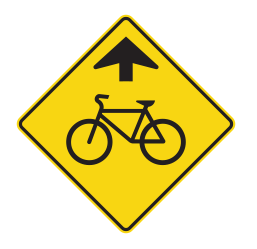
Sign indicating the presence of a designated roadway
Bicycle routes
A bicycle route is a public road, or part of one, on which cyclists are encouraged to ride. See the bicycle route rules to learn more about this type of road.
Paved shoulders
A paved shoulder is a shoulder on which the pavement surface has been extended. The shoulder is separated from the roadway by pavement markings. Paved shoulders are intended to improve the safety of cyclists. They must ride in the same direction as traffic.
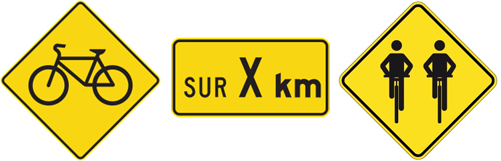
Signs indicating the presence of cyclists on the paved shoulder of a road
Route verte
Québec has a network of cycling trails that is over 5,000 km long, called the “Route verte”. It represents 42% of the approximately 12,000 km of trails crisscrossing the province.
In addition, throughout the network and its regional branches, there are more than 500 tourist accommodation establishments and campsites that are certified “Bienvenue cyclistes!” This means that they offer services and accommodations designed specifically for the needs of cyclists.
For more information about this network, go to
See also
Last update: July 13, 2026