- Home
- Transports
- Traffic and road safety
- Traffic rules and tips for various modes of transportation
- Bicycles and electric bikes
- Traffic rules
Traffic rules for cyclists
When riding a bicycle on Québec roads, you must follow most of the same traffic rules as motor vehicle drivers. However, some rules are specific to cyclists, whether you are riding a regular bike or an electric bike (also called e-bike or power-assisted bike).
Safely riding a bicycle
When riding a bicycle on a public roadway (such as a street or bikeway):
- Be seated astride, which is to say, with one leg on each side of the seat.
- Keep hold of the handlebars.
- Don’t carry any animals or objects that obstruct your vision or interfere with your riding.
When riding with other people, ride in a single file (not side by side).
Before making a turn, signal your intention over a sufficient distance, unless doing so endangers your safety.
To signal your intention of turning:
- left – stick out your left arm and point left.
- right – stick out your right arm and point right or hold your left forearm straight up.
Places to ride a bicycle and applicable rules
You can ride your bicycle on the roadway, a shoulder, a bikeway, a shared street and, in some circumstances, a sidewalk.
On the roadway
On the roadway, ride your bicycle:
- in the same direction as traffic or in the direction indicated by a sign for cyclists
- as close as possible to the curb or right side of the roadway, taking into account the condition of the road and the risk of hitting the open door of a stopped vehicle
- to the left of a lane reserved for right turns if you wish to continue straight ahead
To make a left turn, however, you can use the part of the roadway that makes your manoeuvre easiest.
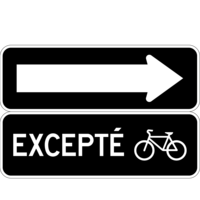
Sign indicating a one-way street that cyclists are not required to follow
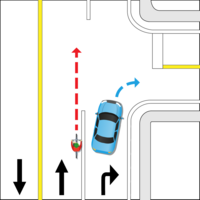
Example of a cyclist riding straight ahead who moves to the left of a lane reserved for right turns
Visit the
On a bike route
On bicycle routes, some rules change to facilitate cycling and to protect cyclists. For more information, visit the Bicycle route rules page.
On the sidewalk
Stay off the sidewalk when biking, unless signs say it is okay.
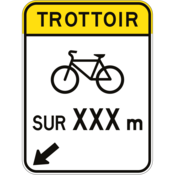
Sign indicating that cyclists may share the sidewalk with pedestrians for a specified distance
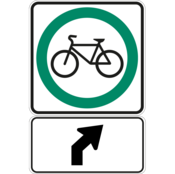
Sign for cyclists indicating that they must use a specific route, in this case the sidewalk
When using the sidewalk, ride at a safe and reasonable speed and yield to pedestrians. There is no speed limit, because it depends on a number of factors, including:
- the presence of pedestrians
- the width of the sidewalk
- the presence of urban furniture
- other obstacles that may impede traffic flow or visibility
When approaching a pedestrian, slow down and make sure, if possible, that they have seen or heard you.
You may pass a pedestrian or cross their path only if there is enough space.
On a shared street
When riding on a shared street, the same traffic rules apply as on the rest of the road network. Pedestrians always have priority. To learn more, visit the Driving on a shared street page.
On a bikeway
A bikeway is a lane designed to accommodate cyclists and promote safe, comfortable travel.
You can’t may not ride a bicycle:
- on limited-access roads like a highway or its entrance or exit ramps
- on sidewalks, except where necessary or where directed or authorized to do so by a sign
- anywhere that has a No cycling sign
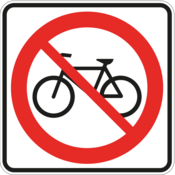
Sign indicating that cycling is not allowed
Children under the age of 12 are not allowed to ride on roads where the speed limit is greater than 50 km/h, unless one of the following conditions is met:
- The bikeway lane is separated from the roadway by a physical barrier.
- They are participating in an activity supervised by a person who is 18 years or older.
Sharing the road
Treat others with respect and help keep the road safe for everyone.
Always yield to pedestrians, including:
- at crosswalks
- when they are crossing at intersections with the walk signal
- at bus stops where people cross bikeways
- on shared streets
Vehicles not allowed on public roads
Some vehicles that resemble mopeds, scooters or motorcycles and are sold as electric bikes are not allowed on public roads, bikeways or sidewalks.
These vehicles do not bear a certification mark indicating that they comply with Canada Motor Vehicle Safety Standards (CMVSS). This restriction does not apply to electric scooters or other motorized personal mobility devices.
These vehicles pose a safety risk to other road users because of their considerable weight and the speeds they can reach. They are already banned from sale in Québec and from being imported new to the province, because they don’t meet current safety standards.
See also
Last update: September 15, 2026