- Home
- Transports
- Traffic and road safety
- Traffic rules and tips for various modes of transportation
- Electric scooters and other motorized personal mobility devices
Rules for using electric scooters and other motorized personal mobility devices
Did you know that electric scooters, electric unicycles and similar means of transport are allowed on public roads? However, you need to follow certain rules.
Ongoing pilot project
The government is currently carrying out a pilot project on motorized personal mobility devices (MPMD), with the aim of establishing the mandatory characteristics of these devices, the equipment required and the rules for operating them.
These devices may be used on roads with a speed limit of 50 km/h or less, and on bikeways located along those roads.
The maximum permitted speed for these devices is 25 km/h.
Users must be at least 14 years old, wear a helmet, and follow the same traffic rules and regulations as cyclists.
Definition of an MPMD
A transport device that:
Is fitted with at least one wheel.
Is powered exclusively by electric motors.
Does not have a passenger compartment enclosed by a rigid or soft, transparent or opaque material.
Examples: electric scooter and electric unicycle.


Devices NOT considered as MPMDs: motorcycles and mopeds, assisted bicycles, motorized mobility aids, motorized toy vehicles and off-road vehicles are not motorized personal mobility devices covered by the pilot project.
Characteristics and mandatory equipment
For use on public roads, the device must:
- Weigh no more than 36 kg, including the battery.
- Have one or more wheels, each with a diameter of at least 190 mm.
- Be equipped with one or more electric motors whose propulsive effect ceases when the device reaches a maximum speed of 25 km/h.
- Be equipped with a brake on each wheel (a wheel fitted with an electric motor allowing the machine to be brought to a halt quickly and efficiently is considered to be fitted with a brake).
- With the exception of an electric unicycle, be equipped with at least two braking systems operated by separate controls, one of which must be mechanical (e.g., a disc or drum brake).
- When equipped with handlebars, allow at least one mechanical brake system to be operated by hand.
Safety tip
For better traction and safer riding, it is recommended to use a device equipped with tires that are in good condition. It is also advisable to check tire pressure regularly and ensure it meets the manufacturer’s recommendations. Properly maintained tires help improve the device’s stability, particularly when manoeuvring and braking.
Reflectors, headlights and lights
Reflectors and lights must be visible at all times from at least 150 m away. They must also be free of any obstructing matter that reduces their effectiveness.
The device must be equipped with reflectors or reflective material that is:
- white at the front
- red at the rear
- red on each side, positioned as close to the rear as possible
Exception: The device may be exempt if the user is wearing clothing or an accessory (e.g., backpack, helmet) with reflective material that is visible to other road users.
At night, headlights and lights must be on at all times. This means that the device must be equipped with:
- a red taillight, which may be a flashing light
- a white headlight or white light at the front, which may also be a flashing light
Exception: The device may be exempt if the user wears a light visible to other road users.
Rules for operating these devices on roads and on some bicycle paths
To ride on roads and some bike paths, you must be at least 14 years old and carry a document that can prove your age. You must wear a helmet that is correctly adjusted and firmly attached.
Also, you must not exceed a speed of 25 km/h at any time.
If you are using an electric unicycle or any other device without hand support, you must wear:
- closed shoes
- protective elbow pads
- protective knee pads
- gloves or any other protective equipment designed to protect the hands or wrists
Traffic rules are similar to those for cyclists:
- Ride as close as possible to the curb or right side of the roadway and in the same direction as traffic.
- Ride on the shoulder in the same direction as traffic.
- Do not use the sidewalk, except in exceptional circumstances.
- Yield to pedestrians at crosswalks.
- Follow the
signs and signals that apply to cyclists .
Safety tip
It is important to adjust your riding to suit weather conditions, traffic volume, and road surface conditions. Hazards such as sand, leaves, cracks and standing water can reduce tire traction and affect the device’s stability. These conditions can increase the risk of losing control, particularly when turning or braking.
Restrictions
When operating an MPMD, you must not:
Wear headphones.
Pull a trailer.
Carry passengers.
Pull or push any other object or person.
Travel on a public road where the speed limit is greater than 50 km/h.
Use a display screen, cellular phone or any other portable device designed to transmit or receive information or to be used for entertainment purposes.
However, there are exceptions. You may use a screen or cell phone if:
The device is properly and securely installed on the MPMD and only broadcasts information necessary for your movement or related to the operation of the equipment.
You are stationary at the edge of the roadway or on the shoulder, in such a way as not to impede traffic.
Municipalities may, by means of the following signage, prohibit the circulation of MPMDs on a bikeway or public road.
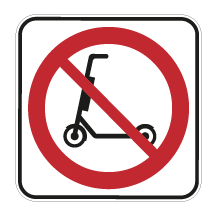
Fines for non-compliance with rules
Users who fail to follow the rules or have the mandatory equipment may be liable to a fine ranging from $100 to $200, depending on the type of offence.
For drivers of road vehicles and other road users
Act in the same way with MPMD users as you would with cyclists:
- Reduce speed and keep a distance of at least 1 m when passing in the same lane.
- Before turning at the intersection, yield to the MPMD user when they wish to cross the roadway.
Important note regarding the application of the pilot project rules
Although the pilot project primarily applies to public roads, its rules also apply on private roads open to public vehicle traffic, on shopping centre parking lots and roadways, and on other areas where the public is permitted to travel.
Information sheet
To find out more, download the information sheet on motorized personal mobility devices (in French only) (PDF 349 Kb).
See also
Last update: October 20, 2026