- Home
- Health
- Advice and prevention
- Screening and carrier testing offer
- Lung cancer screening
- Information about lung cancer screening
Information about lung cancer screening
Lung cancer screening aims to detect cancer at an early stage, before the symptoms of the disease appear. This increases the chances of being able to treat and cure the disease. It is the most effective way to prevent the consequences of lung cancer.
Who is eligible
Screening is for people who have a high risk of developing lung cancer. You may be eligible for lung cancer screening if you:
- are between 55 and 74 years old
- are in one of the following situations:
- you have been an active smoker for at least 20 years (continuously or on and off)
- you have quit smoking but were a smoker for at least 20 years (continuously or on and off)
- have health insurance from the Régie de l’assurance maladie du Québec (RAMQ)
Please note: even if you meet these criteria, you may not be eligible for screening. To check if you are eligible, you will be asked questions to check your risk of developing lung cancer, assess your overall health and ensure screening is suitable for you. To learn more, see the section below How to participate in lung cancer screening.
People who have symptoms of lung cancer or who have already had lung cancer are not eligible for screening. They should have personalized medical follow-up adapted to their situation.
Examination and frequency of screening
The examination to screen for lung cancer is low-dose computed tomography (LDCT). This medical imaging technique is used to obtain detailed images of the lungs in three dimensions and to detect the presence of abnormalities (nodules) in the lungs. The examination is also used to view other organs in the chest (such as the liver, heart, thyroid, breasts, etc.).
The examination is performed by a medical imaging technologist. The technologist asks the person to lie down on the table of the scanner, with their arms above their head. The table is slid into the short cylinder of the machine. During the examination, the person must stay still and hold their breath for a few seconds. The examination is painless, takes less than five minutes and does not require the injection of contrast media.
The examination is done annually, for as long as the person is eligible for screening.
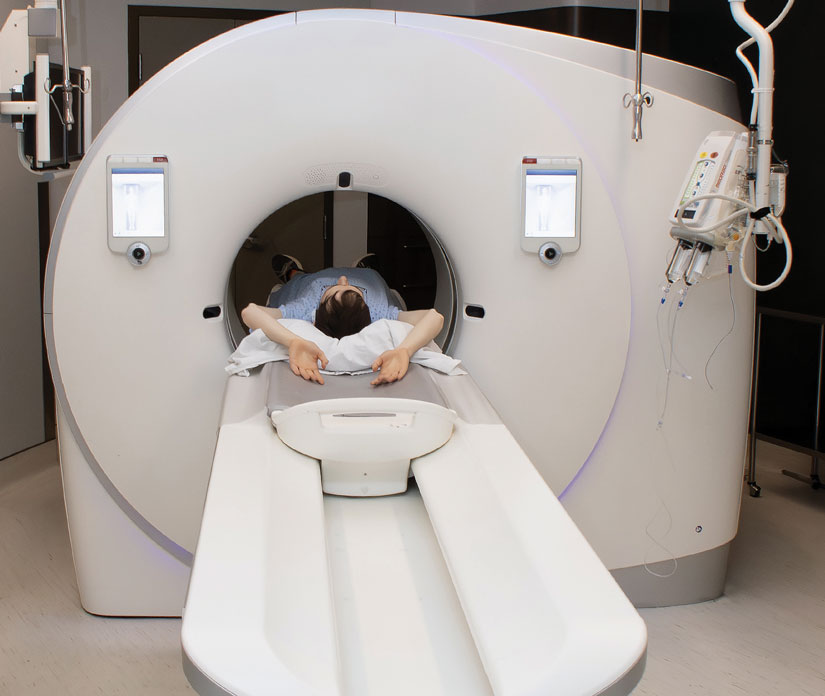
Low-dose computed tomography (LDCT): the examination to screen for lung cancer – Photo: Institut universitaire de cardiologie et de pneumologie de Québec – Université Laval
Advantages, disadvantages and limitations of screening
It is important to find out about the advantages, disadvantages and limitations of screening in order to have all the information you need to make an informed decision. If necessary, discuss it with a health and social services professional. Each person can decide, based on their values, preferences and priorities, whether or not to undergo screening. So it is normal for some people to agree to undergo screening and for others to refuse or to wait before doing so.
Here are a few aspects to consider to help you decide. You can also consult
Video - Advantages or disadvantages of participating in lung cancer screening: make a decision based on what’s most important to you (in French with English subtitles)
Watch the video
Disclaimer: the video player is YouTube’s and may have some accessibility barriers. You can skip to the content after the video
Disclaimer: the video player is YouTube’s and may have some accessibility barriers. You can skip to the content before the video.
Advantages of lung cancer screening
Participation in lung cancer screening can:
- allow cancer to be discovered early, before symptoms appear and before it has begun to spread to other parts of the body. Discovering lung cancer early increases the chances of being able to treat and cure it
- reduce the risk of dying from lung cancer. People who participate in screening have a lower risk of dying from lung cancer than non-participants
- reduce the risk of health problems related to lung cancer or lung cancer treatments, since screening often makes it possible to detect cancer at an earlier stage
- offer the possibility of discovering an abnormality other than lung cancer during the screening examination. Indeed, in addition to the lungs, during the screening examination, other organs in the chest can be visualized (such as the liver, heart, thyroid, breasts, etc.). Treating the abnormality (if you did not already know about it) will prevent complications
- provide access to smoking cessation support services. People who smoke or who quit smoking less than six months previously will be offered support to quit smoking as part of the screening process. Quitting smoking is the best way to reduce the risk of developing lung cancer
Disadvantages of lung cancer screening
Participation in lung cancer screening may, however, have some disadvantages:
- periods of waiting and worry, especially when further examinations are needed
- the possibility of having to undergo further examinations or procedures, such as a a biopsy or surgery, if the result of the screening examination shows a higher risk of cancer
- the possibility that the screening examination result is a false positive. Further examinations will have to be carried out to confirm whether or not it is cancer. If these other examinations show that it is not cancer, they could have been avoided
- the possibility of overdiagnosis. Overdiagnosis is the discovery of a cancer or another abnormality that would never have been detected without screening and which would never have had any health effects or consequences for the person’s life, for example a cancer that develops very slowly or a harmless cancer. As it is impossible to differentiate between harmless and deadly cancers, all cancers are treated. This means that a person who participates in screening could:
- receive treatments that were not necessary
- have side effects from these treatments
- have to live with a cancer diagnosis
- have frequent medical appointments to check that the cancer is not returning
- live with anxiety about the cancer
- exposure to radiation. As with any medical imaging examination, radiation is emitted during the lung cancer screening examination. However, the risk of developing cancer due to the radiation emitted during the examination is extremely low for people who participate in screening
Limitations of lung cancer screening
Participation in screening does not guarantee that all lung cancers will be detected and that everyone who has lung cancer will survive.
Some people who get a negative or benign result on the screening examination will nonetheless develop cancer. This can happen if the cancer was not visible on the examination or had not developed yet when the examination was done.
It is impossible to know in advance which participants will experience the advantages or disadvantages of screening.
How to participate in lung cancer screening
If you meet the eligibility criteria and are interested in screening, discuss it with your doctor or specialized nurse practitioner (SPN). They can send a request to the Regional Service Coordination Centre (RSCC) in your region to check if you are eligible. You can also contact the RSCC in your region directly (whether or not you have a family doctor).
Lanaudière area
Laval area
Elsewhere in Québec
Any eligible person can participate in lung cancer screening, regardless of where they live in Québec. Even if screening is not available in your region, you will be able to participate at the facility closest to where you live. Travel expenses, if any, will be your responsibility.
RSCC staff will contact you to:
- check if you are eligible for screening. You will be asked questions to assess your risk of developing lung cancer, your overall health and ensure that screening is suitable for you
- offer you smoking cessation support services (
I QUIT NOW helpline andsmoking cessation centres ) if you smoke or if you quit smoking less than six months previously - discuss the possible advantages and disadvantages of screening and offer you support in deciding whether to participate or not
RSCC staff do not respond to medical requests. For medical requests, consult your doctor, your SNP or the Primary Care Access Point.
If you are eligible and would like to participate in lung cancer screening, RSCC staff will send a request to the facility closest to where you live for you to have the examination. Do not hesitate to say if you have any preferences regarding the facility. The facility’s imaging department will contact you to schedule an appointment and give you the instructions to follow for the examination.
On the day of the examination, arrive 15 minutes before your appointment time and bring:
- your health insurance card
- your hospital card (if requested by the facility)
Possible screening results
Once the examination has been completed, the images are analyzed by a radiologist.
The result may be:
- negative: no nodules were detected in your lungs or one or more nodules were found, but do not show any signs of cancer
- benign: one or more nodules were detected in your lungs, but the risk of them being cancerous is very low
In both situations, you will be contacted again a year later to have another screening examination. It is important to repeat the examination every year because a negative or benign result does not guarantee there is no cancer (the cancer may not be visible on the examination) or that cancer will not develop later. Cancer can also develop between examinations.
Important! Even if the result of your examination is negative or benign, consult a doctor or specialized nurse practitioner (SNP) immediately if you notice the appearance of symptoms of lung cancer.
- positive: one or more nodules were detected in your lungs. The nodules are not necessarily cancerous. Follow-ups will, however, have to be done.
If it is unlikely that the nodule(s) are cancerous, you will be offered another screening examination a few months later, as recommended by the radiologist. If the probability of the nodule(s) being cancerous is higher, further investigation will be necessary. Additional examinations will be prescribed. A medical specialist will take charge of your follow-up
You will receive the result a few weeks after your examination. The result will also be sent to your family doctor or SNP, if you have one.
Additional examinations
If the result of the screening examination is positive, closer follow-up or additional examinations may be necessary.
Types of additional examinations
Below are a few examples of additional examinations that may be done. If you need to have additional examinations, the ones that are recommended will be adapted to your situation.
- CT scan with contrast agent: medical imaging technique in which a contrast medium is injected to improve the visualization of anatomical structures
- Positron emission tomography scan (PET scan): medical imaging technique that shows the activity of cancer cells and inflammation
- Bronchoscopy: examination that involves inserting a flexible tube into the trachea and bronchi to allow the doctor to see inside them. During the examination, the pulmonologist may take tissue samples from the trachea, bronchi or a possible tumour
- Biopsy: removal of cells or tissues
- Magnetic resonance imaging scan (MRI): examination that provides a view of the inside of organs using magnetic fields
Preparation for additional examinations
You will be given the instructions to follow for the examinations when your appointment is scheduled. Ask how long it will take to get the results.
If you have any fears or concerns about having additional examinations, do not hesitate to discuss them with your doctor or specialized nurse practitioner (SNP). You can also get information and support from the staff in the Regional Service Coordination Centre in your region.
See also
Last update: July 6, 2026