- Home
- Tourism and recreation
- Sporting and outdoor activities
- Sport hunting
- General rules
- Transportation and exports
Game transportation and exports
Transportation coupons
As soon as you have killed a white-tailed deer, a moose, a black bear or a wild turkey, you must use the transportation coupon from your licence by identifying your animal with the unique number. You may affix, in an indelible and legible manner, the unique number from your transportation coupon to the animal. You may affix a printed copy of your transportation coupon attached to your licence purchased online, or simply affix the unique number of the transportation coupon on another medium. This must be done in such a way that the information remains legible and attached to the animal at all times. If you have a paper licence purchased from a sales agent, you may detach the transportation coupon attached to it and affix it to the animal.
Special rules apply if you hunt antlerless deer or if you hunt deer as part of a group in wildlife reserve, exclusive-rights outfitter and certain ZECs, or if you share your licence to hunt moose whitout antlers in a wildlife reserve.
Additional transportation coupons for moose
If you kill a moose, you must ensure the unique numbers of the additional transportation coupons, in a number corresponding to the number of licences required per moose, are affixed to the animal on the same day it is killed. You may affix a printed copy of these transportation coupons attached to the licences purchased online, write the unique numbers directly on the moose, or simply affix the unique numbers of the transportation coupons on another medium. This must be done in such a way that the information remains legible and securely attached to the animal at all times.
Every unique number of an additional coupon must come from the hunting licence of an individual:
- who is legally entitled to hunt moose using a permitted weapon, during the period and in the area (zone, wildlife reserve, exclusive-rights outfitter or ZEC) where this animal was killed;
- who took part in the hunting expedition during which this animal was killed.
When a hunting licence for moose without antlers is shared among the members of a hunting expedition, the holder of the hunting licence for moose without antlers must affix the unique number from the transportation coupon to the moose without antlers killed, under that licence, by a member of the expedition.
Furthermore, if the moose was killed in a ZEC, all the additional coupons must come from the licences of individuals who, before the animal was killed, had paid the requisite fee to hunt moose in the ZEC, and had registered when entering the ZEC.
During a moose hunt subject to a quota in a wildlife reserve, and regardless of whether the group is a single group or a double group, the person who kills the animal must ensure that another unique number of a transportation coupon from the hunting licence of a person in the same group is attached to the animal on the day it is killed. Each person whose unique transportation coupon number was attached to the animal is then deemed to have reached their annual bag limit for moose.
Transportation coupon of a young person hunting under another licence
In wildlife reserves, a single group of four hunters may accept a fifth hunter, provided he or she is a young person or student (see the section on Bag limits in wildlife reserves). The same applies to a double group of seven or eight hunters, who may accept no more than two additional hunters on the same conditions. Such an additional hunter, if a holder of a moose hunting licence, may affix the unique number of the transportation coupon from their licence on the animal killed, in the same way as any other group member. If the additional hunter does not have a moose hunting licence and is hunting under the licence of an adult member of the group, he or she will be deemed to have reached his or her moose bag limit and may not participate in the registration of another moose during the current year.
A young hunter who kills a big game animal or a wild turkey under a regular licence must attach the unique number of the transportation coupon from the licence under which he or she hunted, and must then comply with all subsequent requirements, including registration of the game in his or her name.
When all the transportation coupons from the licence have been used, neither the young hunter nor the adult licence holder can continue to hunt the animal in question, for the rest of that year.
When a young hunter kills an antlerless deer under an adult’s antlerless deer hunting licence, the young hunter must comply with all obligations, such as registering the antlerless deer in its name. Once the licence has been used, the privilege to kill an antlerless deer under this licence expires, but the licence remains valid to kill a buck if the transportation coupon is still valid and has not been used. The same rule applies to the hunting licence for moose without antlers.
Species-specific transportation rules
Below are the specific transportation rules applicable to game animals before online registration or during in-person registration. The animal’s condition may be checked by a wildlife protection officer or registration station delegate.
Transporting a moose
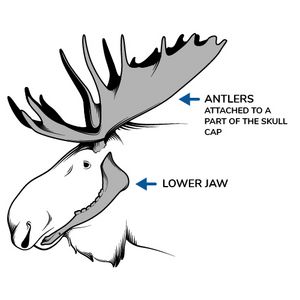
When you kill a moose, you must transport and produce it whole or in identifiable quarters at a registration station.
In the case of a moose produced in quarters, you must also produce and make available the whole head, failing which you must produce and make available the full lower jaw and, in the case of a male, the antlers attached to the full or partial calvarium.
Sharing moose flesh with other hunters
After killing a moose and registering it, you may separate the flesh for transportation to your respective butchers.
You must each keep a copy of the proof of registration, so that you are able to confirm the source of the meat if you are asked to do so by a wildlife protection officer or wildlife protection assistant.
Transporting a white-tailed deer

After killing a white-tailed deer, you must transport it to a registration station and produce it whole or in two approximately equal parts separated transversally along the floating ribs or the kidneys, as shown in the diagram.
In addition, if the deer is divided into two parts, you must present both parts without removing the head and the external genital organs (scrotum or vulva) from either part of the animal.
In no case should the skin or hooves be removed from the animal before it is registered.
Transporting a black bear
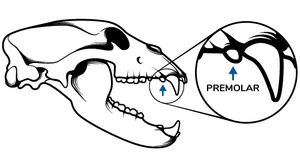
If you kill a black bear, you must present the carcass or pelt of the animal to an officer upon request, or when registering the animal at a registration station.
To facilitate the management of black bear, hunters are asked, at registration, to provide the two upper premolars (see the diagram) and to indicate the date and exact location of the kill, along with the animal’s gender and the presence or absence of milk.
The premolars are located directly behind the canines. They can easily be removed as follows:
- Use a sharp knife to free the tooth from the gum.
- Thrust the tip of the knife into the gum between the canine and the premolar and dislodge the tooth with a slight twisting motion.
- Do not wash or boil the teeth.
The operation is identical for both premolars. To avoid confusing one animal with another, you should place both teeth and the required information for each black bear in a separate envelope. The premolars are not always apparent in older animals.
Transporting a wild turkey
If you kill a wild turkey, you must transport it and present it whole, eviscerated or not, at a registration station.
Restrictions relating to chronic wasting disease in cervids
The government has introduced measures to protect wild cervid herds and continues to take action to reduce the risk that chronic wasting disease (CWD) will become established in wild populations.
Below are the regulatory restrictions that apply to the transportation of anatomical parts of cervids that died outside Québec.
Rules governing imports carcasses and certain parts of cervids
It is forbidden to import or possess whole carcasses and certain anatomical parts of cervids (except caribou) killed outside Québec. In cervids with CWD, pathogenic prions are concentrated in the organs concerned.
If you hunt outside Québec:
- Avoid hunting in or near
sectors where CWD has been detected . - If the authorities of the province or state where you killed the cervid informs you that the animal has CWD, please notify SOS Poaching – Wildlife Emergency by calling 1 800 463-2191.
Targeted anatomical parts
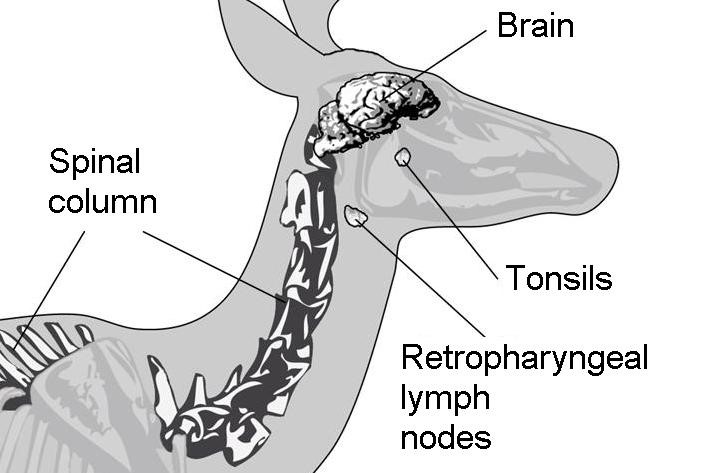
Anatomical parts that are subject to transportation restrictions.
Anatomical parts with movement restrictions:
- The head, more specifically any part of the brain, the eyes, the retropharyngeal lymph nodes and the tonsils (at the base of the jaw)
- Any part of the spine
- The reproductive organs
- The internal organs (spleen, heart, kidneys, mammary glands, bladder, etc.)
- The skin that has no had the fat removed.
Anatomical parts that can be moved without restriction:
- The meat or quarters, provided they do not contain any of the anatomical parts targeted by movement restrictions.
- The skin tanned with the fat removed, and the hide.
- The antlers with no velvet.
- The skull, the bones of the spine, the teeth and the hooves that have been cleaned of all soft tissue and disinfected*.
- The bones that are not covered by the preceding item.
* To disinfect the skull, the bones of the spine, the teeth and the hooves, soak them in a solution containing at least 2% sodium hypochlorite (generally this is a mixture of 50% bleach and 50% water) for 15 to 20 minutes.
Export big game outside of Québec
The unique transportation coupon number affixed to the animal and proof of registration allow for the transportation of big game or part of it, including fur, outside Québec. This applies to residents and to non-residents who have held a valid Québec big game hunting or trapping licence. However, if the animal is a black bear, a
To obtain a CITES permit, which is issued by the Canadian government, please visit the website of
In addition, to export raw fur out of Québec for commercial purposes, a person must hold a raw fur dealer’s or tanner’s licence. However, such a licence is not required from a resident if the product is from their own hunt. An export permit may also be required, depending on the destination. In this case, a regional wildlife management office can provide the export form issued by the Ministère de l’Environnement, de la Lutte contre les changements climatiques, de la Faune et des Parcs.
All 2026-2028 new hunting rules
Printable version.
Biodiversity, Wildlife and Parks – Client Services
-
Monday, Tuesday, Thursday and Friday: from 8:30 a.m. to 12 p.m. and from 1 p.m. to 4:30 p.m.
Wednesday: from 10 a.m. to 12 p.m. and from 1 p.m. to 4:30 p.m.
-
Regulatory information: 1-877-346-6763
-
Last update: August 24, 2026