- Home
- Transports
- Traffic and road safety
- Traffic rules and tips for all vehicles
- Traffic lanes
- Safe driving behaviour
Safe driving behaviour
Two-way roadway
When there is one lane in each direction, you must use the right-hand lane. However, to pass another vehicle or when the lane is blocked or closed, you must use the other lane, but you must first yield to any on-coming vehicles.
If there is more than one lane in the same direction, you must use the far-right lane. You may use another lane, however, when passing (overtaking) another vehicle or making a left turn, or when the far-right lane is blocked or closed.
Roadway with two or more lanes of traffic in the same direction (e.g., a highway)
On this type of road, you must drive in the far-right lane or, if there are three or more lanes, in one of the right-hand lanes.
If the speed limit is less than 80 km/h, you may use any lane. In this case, driving faster in one lane than in another is not considered passing. If you are driving slower than the flow of traffic, however, you must drive in the far-right lane, unless you are preparing to turn left, park or stop on the left-hand side. In that case, signal your intention.
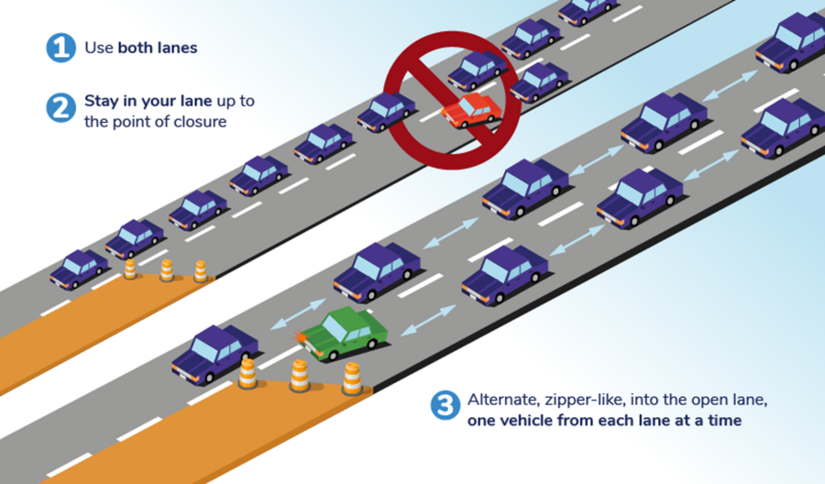
Merging two streams of traffic using the late (or “zipper”) merge strategy
When driving in a lane that is coming to an end or is closed due to roadwork, use the zipper merge strategy. To do so:
- Slow down.
- Wait until the last moment before moving into the open lane.
- Merge into the open lane, alternating (zipper-like) with the vehicles already in that lane.
If you are already driving in the open lane, be sure to leave enough space to allow a vehicle from the closed lane to merge. Do not prevent other drivers from reaching the merge point by blocking the merging lane.
Watch the
Two-way left-turn lane
When a two-way left-turn lane is provided, you may not use it for passing.

Example of a two-way left-turn lane
Buses travelling on a reserved shoulder
Some buses are allowed to travel on specific sections of the shoulder, which is called the Bus on Shoulder or “BOS” system.
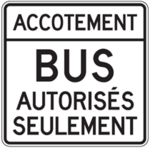
This sign indicates that authorized buses may use the shoulder.
Requirement to signal your intentions
You must signal your intentions in advance with your direction indicator lights (also called turn signals) before:
- making a turn
- changing lanes
- making a U-turn
- signalling your exit from a traffic circle
- re-entering the roadway while on the shoulder or in a parking area located on the side of the roadway
Principle of caution
Drivers must exercise caution toward more vulnerable road users, including people with reduced mobility, cyclists, pedestrians and people who, in the course of their duties, are working on foot on a public road.
Vulnerable road users, in turn, must adopt behaviours that promote their safety.
See also
Last update: July 13, 2026