- Home
- Transports
- Traffic and road safety
- Traffic rules and tips for various modes of transportation
- Pedestrians
- Pedestrian lights
Traffic rules for pedestrian lights
Pedestrian lights give people on foot the right of way to cross. A digital counter displays the time available to cross the street.
Meaning of the pictograms and digital counter
Make sure you understand what the lights are indicating. Always cross with caution and pay special attention to vehicles that may be turning.
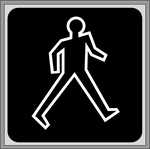
The steady white silhouette indicates that pedestrians may cross the roadway in the corridor reserved for this purpose.
The flashing orange hand with a numerical countdown indicates that pedestrians can start to cross only if they are able to reach the sidewalk on the other side of the street or the safety zone before the hand stops flashing. It’s up to the pedestrian to judge whether or not they can cross.

A flashing orange hand without a numerical countdown means that the pedestrian who has already started to cross should walk faster in order to reach the sidewalk or shoulder on the opposite side of the road. If the pedestrian has not already started crossing, they should wait until the next walking pedestrian light.

When the countdown is complete, the orange hand stops flashing and remains steady, meaning that pedestrians can no longer cross the road. They must wait for the next white silhouette to appear.

If there is no pedestrian light, pedestrians have the right of way on the green traffic light.
When crossing the road, pedestrians must walk perpendicular to the axis of the road. They may only cross the road diagonally if authorized by a peace officer, school crossing guard or sign.
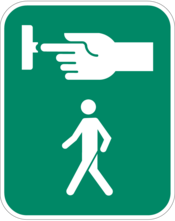
To cross, simply press the push button when the traffic light is red and wait for the white pedestrian silhouette to appear. If you press the button while the light is green, the signal will be recorded in the next cycle. In any case, a small light confirms the registration of the pedestrian crossing request.
Calculating the time to cross
Crossing time is calculated by dividing the width of the street to cross by the pedestrian walking speed. This varies from 0.8 m/s to 1.3 m/s. For example, for a 12 m long crosswalk, the crossing time will be 12 s if the walking speed is 1 m/s.
Turning right at a red light
Pedestrians should be particularly careful when other road users are allowed to turn right at a red light. In this situation, before crossing, they should look left, ahead, right, and then over their left shoulder to make sure that there are no vehicles about to turn on the red light.
Operating mode for pedestrian lights
Pedestrian lights can operate in three modes.
In protected mode, vehicles are prohibited from moving, including making right turns at a red light, during the entire pedestrian phase.
In partially protected mode, some vehicle movements are prohibited during the first part of the pedestrian phase and then allowed afterwards. For example, the traffic light may display the green forward arrow (straight ahead) during the pedestrian crossing phase, and then give way to the green light allowing movement in all directions. However, turning right on a red light remains prohibited.
In permissive mode, some vehicle movements are permitted during the pedestrian phase, including turning right at a red light.
Last update: July 13, 2026