- Home
- Health
- Health issues
- A to Z
- Recessive hereditary diseases
- About autosomal recessive hereditary diseases
About autosomal recessive hereditary diseases
Autosomal recessive hereditary diseases
Some autosomal recessive hereditary diseases, also known as genetic diseases, are more common in certain regions of Quebec or among people with certain ethnic backgrounds.
People whose ancestors come from these regions or people who have certain ethnic backgrounds are more likely than the rest of the population to have inherited a genetic variant (change in DNA) in a gene.
For more information about carrier screening, go to the page Carrier screening for autosomal recessive hereditary diseases.
The term parent used on this page includes all possible parenting scenarios, such as adoption, sperm and egg donation, the use of a surrogate mother in the case of a surrogacy project, in vitro fertilization (IVF) and other similar contexts.
DNA is a person's genetic code. Located in the nucleus of each cell, DNA contains all the genes. To make it easier to understand, a person's genetic code can be compared to a large library (DNA) filled with cookbooks (genes).
Genes give instructions to ensure the body functions properly, such as how to make proteins, which are essential for organs and cells to function.
A person inherits 2 copies of each gene transmitted by each of their biological parents, one copy transmitted by the egg and the other by the sperm.
A variant is a change or difference in a gene, much like when an ingredient (variant) in a recipe (gene) is changed. Some variants have no effect while others can cause, for example, autosomal recessive hereditary diseases.
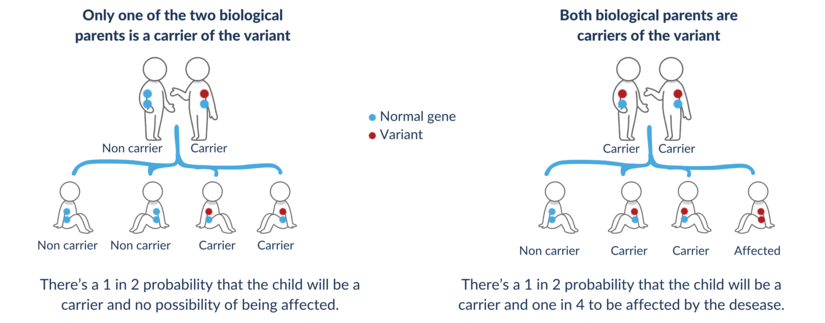
People who are called “carriers":
- have only one variant in only one of the two copies of a gene that causes an autosomal recessive hereditary disease;
- do not have any signs or symptoms of the disease associated with the gene and are not at risk of developing them later;
- can pass the variant on to each of their children.
A person with an autosomal recessive hereditary disease has a variant in each of their two copies of the gene. For this to happen, both of their biological parents carry a variant in the same gene. In this situation, the possible outcomes for each pregnancy are as follows:
- a one in four chance (25% probability) of having a child who does not have the disease and is not a carrier;
- a one in two chance (50% probability) of having a child who is a carrier;
- a one in four chance (25% probability) of having a child who has the disease.
Founder effect
All human beings are carriers of variants in a gene associated with autosomal recessive hereditary diseases.
When a small group of people moves away from a large population to form a new one, they take their genetic make-up, which is not necessarily representative of the genetic make-up of the original population, with them. This means there is less genetic diversity in the new population. If these people carry a variant in a gene associated with autosomal recessive hereditary diseases, these diseases may become more common in the new population. Conversely, there may be fewer people who carry a variant in a gene for a specific disease in the new population compared with the original population. This is called the founder effect.
Most of Quebec's population is descended from fewer than 10,000 ancestors who came over from France in the 17th century. Some of the founders of Quebec’s population were carriers of variants in genes that cause autosomal recessive hereditary diseases.
The founder effect in the Saguenay–Lac-Saint-Jean, Charlevoix and Haute-Côte-Nord regions
In remote regions such as the Saguenay–Lac-Saint-Jean, Charlevoix and Haute-Côte-Nord regions, the founder effect was amplified due to their geographical isolation and high birth rate. This explains why some autosomal recessive hereditary diseases are more common in these regions than in other parts of Quebec.
People whose ancestors come from these regions have about a one in five chance (20% probability) of being carriers of a variant in a gene associated with an autosomal recessive hereditary disease. To find out more, go to the page Autosomal recessive hereditary diseases in people from the Saguenay–Lac-Saint-Jean, Charlevoix and Haute-Côte-Nord regions.
Carrier screening identifies people who are carriers of a variant in a gene associated with autosomal recessive hereditary diseases. Carrier screening is available for people who have at least one biological grandparent who was born in the Saguenay–Lac-Saint-Jean, Charlevoix or Haute-Côte-Nord regions.
To find out more about carrier screening, go to the page Carrier screening for autosomal recessive hereditary diseases in people from the Saguenay–Lac-Saint-Jean, Charlevoix and Haute-Côte-Nord regions.
Last update: April 15, 2025