- Home
- Immigration
- Immigration fraud and the impact on your immigration plans
Immigration fraud and the impact on your immigration plans
Do you plan to apply for temporary or permanent selection in order to work, study or live in Québec? You can choose whether or not to have a third party support you throughout the process; either way, you are responsible for making sure the information in your application is accurate.
Providing false or misleading information could put an end to your immigration journey.
Please read the information below before submitting your application.
False and misleading information or documents and how they can impact your application
You are responsible for all of the information in your application, even if a representative fills it out on your behalf.
Sending any false or misleading information or document may have the following consequences:
- Your application containing false or misleading information may be rejected;
- All of your other applications under review by the minister, even if they do not contain false or misleading information, may be rejected;
- The minister may refuse to review any immigration application submitted to the gouvernement du Québec (Government of Québec) in the next five years for you and all persons mentioned in your application;
- You may have to pay a fine of up to $25,000.
What to check if you use a representative
Bad-faith actors use all kinds of means to mislead persons who plan to immigrate to Québec. Their goal is simple: to get you to send them money or to access your personal data under false pretenses.
No person or organization can guarantee that your immigration application will be approved.
There is no compensation available for victims of fraud related to Québec immigration applications.
If you access the services of a paid immigration representative (consultant, lawyer, notary), here are a few important things to check before entering into any kind of service agreement:
- Make sure your lawyer is a member of the Barreau du Québec (Bar of Québec), your notary is a member of the Chambre des notaires du Québec (Québec Notaries’ Society), your immigration consultant is recognized by the Ministère (Ministry) or holds special authorization from the Barreau du Québec or the Chambre des notaires du Québec. Only representatives from these regulatory bodies are authorized to provide immigration consulting and support services (in French and English);
- Make sure that all of your correspondents are indeed the people they claim to be and that the organizations they represent legally exist. Do not hesitate to request supporting documentation and have it verified by the above-mentioned regulatory bodies;
- Refuse any form of payment requested by representatives who are not registered with the Registre québécois des consultants en immigration (RQCI) (Québec Register of Immigration Consultants) (in French only), the
Barreau du Québec (in French and English) or theChambre des notaires du Québec (in French and English); - Exercise caution when conducting business remotely unless you have already made initial contact with your representative and have verified the legal existence thereof.
Good online habits
- Never sign a blank or partially completed form. Always ask to see all declarations and documents included with your application before submitting them;
- Do not let a third party modify your declarations with false or misleading information in order to increase your chances of receiving an invitation or selection letter from the gouvernement du Québec;
- You are responsible for the privacy and security of your online application. Do not share your usernames or passwords. You must be able to access your application online at any time, since some communications from the Ministère are only sent through your online account;
- All fees charged by the gouvernement du Québec for processing an application are posted online. Make sure they match the information sent by the immigration representative you are paying to help you.
Common online scams
Bad-faith actors use all kinds of fraudulent strategies and scams to give foreign nationals false access to diplomas, employment or expedite the processing of their immigration file. For example:
- Fake websites or fake immigration portals that request payment (money transfers, prepaid cards or cryptocurrency) or personal information. These websites look like official platforms and may promote fake immigration programs, fake contests or fake lotteries for study or work permits;
- Fake officers or consultants claiming to represent the gouvernement du Québec or the Government of Canada;
- Fake service offers related to immigration, fake employment contracts or fake study permits;
- Spreading of false or misleading information on social media (Facebook, Instagram, Snapchat, Telegram, TikTok, YouTube, WhatsApp or X). This type of solicitation and false information may be conveyed through web pages, influencers, instant messaging, groups and forums that may seem official;
- Fake job offers promising quick work permits, scholarships or student loans.
- Fraudulent emails, messages or phone calls.
Tips to protect yourself from fraud:
Make sure websites are legit:
- Ensure that the address in your browser’s address bar is exactly as you typed it;
- Make sure that the website URL contains the following:
- “www.quebec.ca” or “.gouv.qc.ca”;
- Look for a padlock in the browser window and “https://” at the beginning of the URL. These features show that the site is secure and that your data is better protected.
Here are two examples of a secure gouvernement du Québec website:
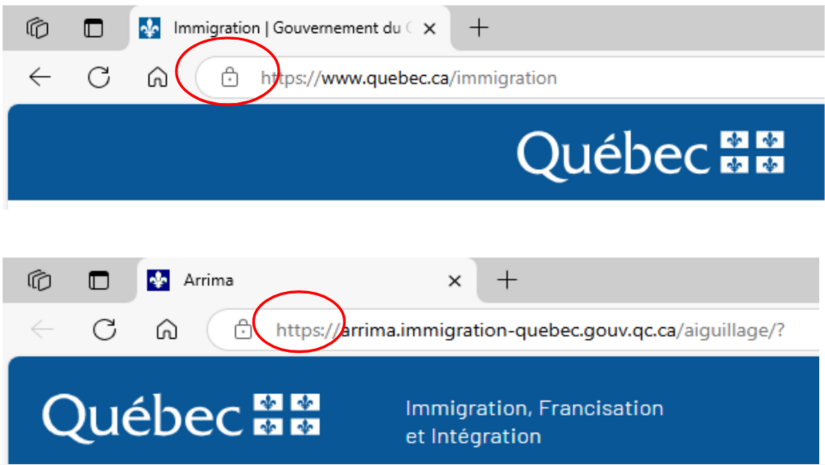
If you have any doubts about the legitimacy of a website or secure platform belonging to the Ministère, please contact our Centre de contacts clientèle (Customer Contact Centre) (in French and English).
Be careful with payment requests:
- Do not pay for guaranteed entry to Québec or Canada, employment or faster processing of your application. These are scams;
- Be wary if you are asked to pay for access to forms or platforms. The Ministère will only charge a fee to process your immigration application;
- Make sure you never deposit money into a personal bank account and do not transfer funds through a private money transfer service (e.g., Western Union, Wise, PayPal).
Communicate with caution:
- Be wary if you receive unsolicited messages (email, instant messaging, etc.) from strangers advertising immigration services;
- Never provide personal information on unsecured websites or social media. Your personal data could be subject to identity theft;
- Be wary if you are asked to communicate using email accounts such as Yahoo!, Outlook, Gmail, Proton, etc. People claiming to represent the government, well-known organizations or large companies often use mainstream email addresses;
- Do not enter your file number on a website. The Ministère will never ask you to enter your file number on its website unless you are using one of its secure platforms.
If you witness or experience fraud
In Québec and Canada, fraud and identity theft are crimes punishable under Canadian law. If you believe you have been the victim of fraud, particularly online, it is important to act quickly.
- Report the situation to the gouvernement du Québec by completing the form (in French and English) available at Québec.ca;
- Report the incident to your local police. Police forces are qualified to handle this type of report and take the necessary steps.
Reporting fraud helps fight illegal activity and protect others from deceptive practices.
Last update: January 6, 2026