- Home
- Public safety and Emergencies
- Emergency situations, disasters and natural hazards
- What to do before, during and after an emergency or a disaster
- Flooding
- Protect your home and property
Protect your home and property in case of flooding
Protect your home from flooding-related damage and preserve your property by following the advice on this page.
Precautions to be taken in the event of imminent flooding
If water threatens to enter your home, follow the instructions below:
- store up high or on a higher floor items in the basement or on the ground floor;
- put in a safe place out of children’s reach chemical or harmful products such as insecticides and used oil residues;
- block sewers in the basement in the absence of a backflow valve;
- block the basement drain;
- use an auxiliary sump pump to evacuate water from your residence if necessary;
- if water enters the basement, do not touch anything. Immediately contact Hydro-Québec at 1-800-790-2424 to turn off the power. If the flood cannot be prevented but water has not yet started coming into the basement, follow the
safety instructions to eliminate the risk of electrocution and fire; - close the main natural gas inlet and remember that a specialist must reopen it; close the valves of propane cylinders and propane tanks;
- remove or anchor cumbersome objects on the lot to avoid their being projected or carried away by water;
- in the event of storm surge or breaking wave alerts, protect windows facing the river with wood panels.
Build a sandbag dike
When the municipality advises you to do so, protect your home from flood waters with a sandbag dike. Contact your municipality to find out how to obtain sandbags.
Follow these steps to install the dike:
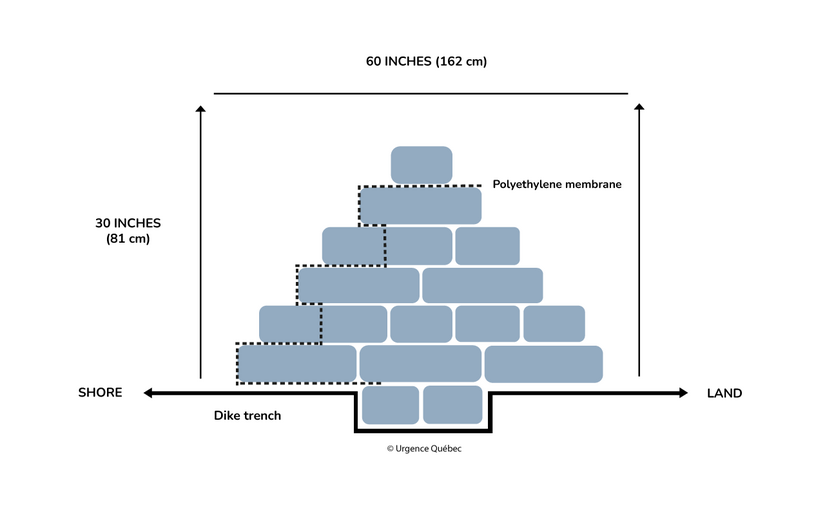
- place the sandbags in the first row perpendicular to the axis of the wall or the shore. If possible, put them on firm ground rather than on ice or snow. To help maintain the dike resist water pressure, it is preferable to dig a trench to serve as a foundation (see the diagram below). The sandbags must not be completely full to ensure that they fit snugly with adjacent bags and better remain in place.
- Lay the bags in alternating crisscross directions to bolsters the dike’s stability.
- Lastly, it is recommended to insert a flexible polyethylene membrane between the sandbags exposed to water to eliminate water seepage. To be effective, the membrane must extend from the ground to the second-last row and form successive “S’s” as suggested in the diagram below.
Preserve your installations and equipment in the event of flooding
Check your installations and equipment to prevent damage and ensure their safe operation. Select the appropriate topic from the following list:
Restarting electrical installations:
- If Hydro-Québec interrupts the service, only a master electrician can restore it.
- If the service has not been interrupted but water has infiltrated the house, consult a master electrician before restoring power. The master electrician will indicate the state of your installation and will do what is necessary to restore it to good working order.
Consult the
Before you use your plumbing fixtures, make sure that the municipal drainage system and your septic system are in working order, then follow
Septic tanks and pumping stations can fill with silt and debris and should be drained and cleaned by professionals. The recommendations listed below are provided to prevent damage.
During a flood
Turn off the electrical systems that power the water treatment systems.
Do not empty your septic tank or retention tanks, as this could damage the structures.
Avoid using treatment systems to prevent possible backflow of wastewater into the residence.
Consult the manufacturer’s guides or contact them for recommendations if the installation includes an NQ 3680-910 certified treatment system.
Avoid or minimize contact with floodwater.
After a flood
If sewage has backed up into your basement, clean the affected area and disinfect the floor.
Avoid using your septic system if the ground is still flooded with water.
As soon as the soil is no longer flooded or waterlogged:
- Have your septic tank, tanks and pumping station, if any, emptied as soon as possible. Fill your septic tank with water;
- Make sure that access covers are secure and that inspection holes have not been blocked or damaged;
- If you have an NQ 3680-910 certified treatment system, follow the recommendations of the manufacturer, its representative or the professional who services it;
- Before restoring power, inspect all electrical connections for damage. Make sure the devices are clean and dry;
- Repair any damage to the ground cover;
- Have your septic system inspected by a qualified septic system professional if you suspect a break or malfunction.
Do not drive over your septic system with a vehicle (at any time).
For more information, see the
Last update: October 27, 2025