- Home
- Transports
- Municipalities
- Road safety in municipalities
- Changing a speed limit
Changing a speed limit on the municipal road network
To change a speed limit on roads under its jurisdiction, a municipality must follow specific legal procedures. Failing to do so may result in the speed limit being challenged or invalidated.
This page explains the steps municipalities must follow to change fixed or variable speed limits on the municipal road network.
Determining the speed limit
Before changing a speed limit, the municipality must first determine whether a change is necessary and identify the most appropriate speed. This assessment must consider, among other factors, road safety and traffic conditions.
Various technical reference documents (available in French only) can support municipalities in their analysis:
- Gestion de la vitesse sur le réseau routier municipal en milieu urbain (PDF 1.39 Mb) [speed management on the municipal road network in urban areas]
- Aide à la détermination des limites de vitesse sur le réseau routier municipal (PDF 0.99 Mb) [guide to setting speed limits on the municipal road network] (rural roads)
- Guide de détermination des limites de vitesse sur les chemins du réseau routier municipal (PDF 742 Kb) [guide to setting speed limits on roads in the municipal road network] (rural roads)
Changing a speed limit on its own does not necessarily improve road safety. Before considering the modification process, the municipality should confirm that a specific issue has been identified. In some cases, other measures – such as traffic-calming measures – may be more effective.
Adopting a bylaw
To change a speed limit on its road network, a municipality must adopt a bylaw or an ordinance.
If the bylaw applies to the entire municipal road network, it cannot refer to categories of roads. Instead, it must list the names of all roads where the speed limit differs from those set out in the
- 50 km/h in residential areas
- 70 km/h on gravel roads
- 90 km/h on paved roads
A bylaw must also be adopted when constructing a new street or extending an existing street if the applicable speed limit differs from those prescribed in the Highway Safety Code.
Municipalities are not required to submit speed limit bylaws or ordinances to the government. The government has no authority to overturn them.
An example of a municipal bylaw for modifying a speed limit on the municipal road network (in French only) (PDF 19.25 Kb) is available.
Installing signage for the new speed limit
The new speed limit sign must be installed only when the municipal bylaw comes into force.
However, when the speed limit is being reduced, the municipality may install a sign announcing the upcoming change. This sign may be installed one month before the bylaw takes effect.
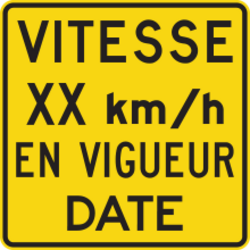
Example of a sign indicating an upcoming speed limit reduction. This sign must be mounted below the new speed limit sign
Within 30 to 60 days after the bylaw comes into force, the municipality may install a sign indicating that the speed limit has changed.
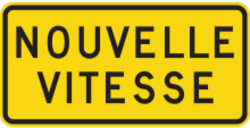
Example of a sign indicating that a new speed limit is in effect. This sign must be mounted below the sign indicating the new speed limit
For more information on speed limit signage and the appropriate signs to use, consult
Implementing a temporary speed limit in a roadwork zone
A different procedure applies when a temporary speed limit is posted in a roadwork zone on the municipal road network.
In this case, any decision to modify an existing speed limit during roadwork must be formally recorded in a register.
For more information, consult the guide for municipalities [in French only] Détermination et enregistrement des limites de vitesse temporaires dans les zones de travaux sur le réseau routier municipal (PDF 5.47 Mb) [determination and registration of temporary speed limits in roadwork zones on the municipal road network].
Last update: July 13, 2026