- Home
- Transports
- Municipalities
- Road safety in municipalities
- Traffic calming
Traffic calming in municipalities
Traffic-calming measures can be implemented in urban areas to improve road safety, particularly for vulnerable users such as pedestrians and cyclists. These measures also promote active transportation and may be applied individually or together, on a temporary or permanent basis.
Examples of traffic-calming measures
A variety of physical measures can be used to influence driver behaviour while improving conditions for other road users. Traffic-calming measures are assessed based on their benefits, limitations, and the costs associated with installation and maintenance. A situation analysis helps identify the most appropriate measures based on local needs.
Municipalities interested in implementing these measures can consult the technical fact sheet on traffic-calming (in French only) (PDF 223 Kb). This document outlines the most common measures used in Québec and presents a recommended implementation approach.
Below are examples of measures that require a lower level of investment and can generally be implemented within a relatively short timeframe.
For more information on the benefits, limitations and installation criteria for these measures, refer to the brochure describing examples of traffic-calming measures (in French only) (PDF 482 Kb).
Radar speed signs
A radar speed sign, also known as a driver feedback sign, displays a vehicle’s speed to remind drivers to respect the posted speed limit. This type of measure generally helps reduce driving speeds, although its effectiveness may be limited on multi lane roads. To maintain its impact and prevent drivers from becoming accustomed to it, the sign should be relocated regularly, typically every two to three weeks.
Radar speed signs are usually installed in locations where speeding is a concern or where there is a higher risk for vulnerable road users. They are most effective in:
- areas with a high volume of pedestrians
- transition zones between two speed limits at the entrance to a built-up area
- school zones
Municipalities wishing to install a radar speed sign within their jurisdiction must submit a request to the Ministère des Transports et de la Mobilité durable. Refer to the page on driver feedback signs (in French only) for additional information on the application process.
Speed limit bollard
A speed limit bollard is installed in the centre of the roadway and used in conjunction with a speed limit sign. It must be positioned opposite the corresponding sign. The bollard reinforces existing signage and creates a temporary narrowing of the travel lanes. The sign mounted on the bollard is identical to the adjacent speed limit sign.
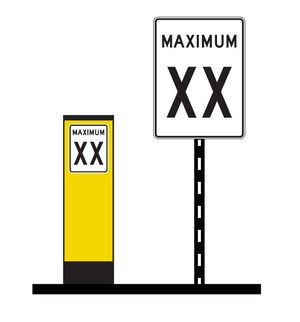
Example of a speed limit bollard installed opposite the corresponding speed limit sign.
Pedestrian bollard
A pedestrian bollard is installed on the roadway, in the centre of a crosswalk. It is used in conjunction with the pedestrian crossing sign to remind drivers of the presence of the crossing.
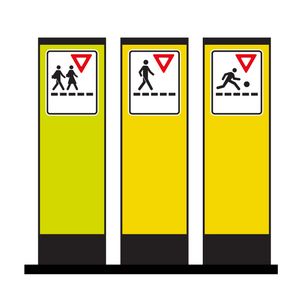
Examples of pedestrian bollards
Delineator bollard
A delineator bollard is a device that gives the impression of lane narrowing or is used to mark lanes reserved for cyclists or pedestrians. It is installed on the centerline (the line separating traffic lanes) or on the edge line (the line separating the roadway from the shoulder, usually on the right).
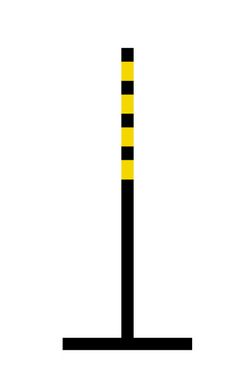
Example of a delineator bollard
Speed humps and speed bumps
A speed hump is a long, gently raised section of roadway that slows vehicles by creating discomfort for drivers. Speed bumps are shorter and steeper than humps. Depending on the width of the roadway, two or three speed bumps may be installed. This measure is reserved for roads with posted speed limits of 30 to 50 km/h.
Speed humps and speed bumps can be constructed in asphalt. Removable rubber models are also available, allowing them to be relocated as needed and facilitating winter road maintenance.
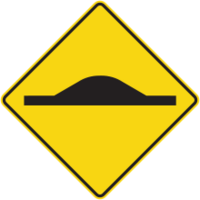
Sign warning drivers about the presence of a speed hump or speed bumps.
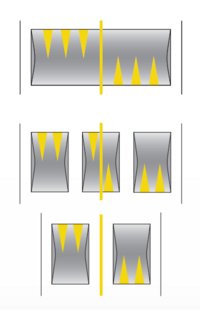
Example of a speed hump and speed bumps
Refer to the technical fact sheet on speed humps and speed bumps (in French only) (PDF 1.21 Mb) for more information on this measure.
Speed limit markings
Speed limit markings on the road surface are used to supplement traffic signs. The speed limit and the word “Maximum” are painted in white in the centre of the lane to make speed limits more visible to drivers.
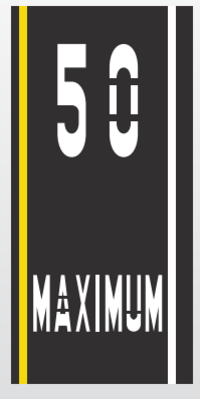
Example of speed limit markings on a road
Advance Speed Limit sign
The Advance Speed Limit sign informs road users of an upcoming reduction in the posted speed limit. It is typically installed where the speed limit is reduced by 30 km/h or more. Installation at locations where the speed limit is reduced by 20 km/h can also provide advance notice and encourage drivers to slow down.
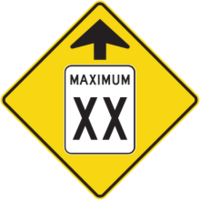
Advance Speed Limit sign
Raised crosswalk
A raised crosswalk is a raised platform that occupies part of the roadway and includes a marked pedestrian crossing. It requires vehicles to slow down when approaching and crossing it.
This type of crosswalk is reserved for roads with posted speed limits of 30 to 50 km/h.
Lane narrowing
Lane narrowing involves reconfiguring road markings to reduce lane width. It creates a dedicated corridor for pedestrians or cyclists along the edge of the roadway, which can help slow vehicle speeds. This measure is simple to implement but may conflict with curbside parking.
Examples of pedestrian safety measures
Safety measures can be implemented to facilitate pedestrian movement, particularly at crossings. These measures naturally encourage drivers to comply with posted speed limits and be more attentive to their surroundings.
Different levels of intervention can be used to meet pedestrian safety objectives, depending on local needs. Below are examples of measures corresponding to each level of intervention. These are proven approaches that can address a range of situations identified through a site-specific analysis.
To learn more about these measures, refer to the examples of measures promoting safe pedestrian travel (in French only) (PDF 371 Kb).
First level of intervention: allocating space among different users
The first level of intervention to improve safety focuses on reallocating the available space on the roadway among different users. Depending on local conditions, the following measures may be implemented:
- roadway redesign
- curb extensions and median islands
- pedestrian, speed limit and delineator bollards
- raised crosswalks or raised intersections
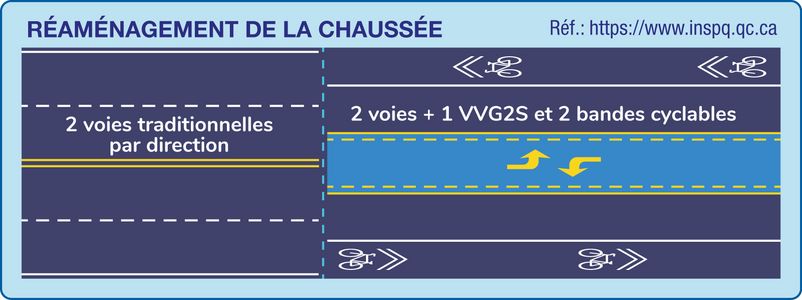
Roadway redesign
The roadway can be redesigned to reduce:
- lane width
- the number of lanes
- shoulder width
Reducing shoulder width can allow, for example, for the creation of a median strip in the centre of the roadway or a two-way left-turn lane with bike lanes.
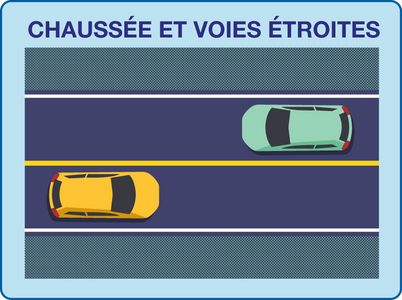
Example of roadway redesign by reducing lane width
Curb extensions and median islands
Curb extensions and median islands offer another way to reallocate roadway space. These features improve pedestrian safety by reducing crossing distances and encouraging vehicles to slow down, as lanes or the roadway itself are narrowed.
The space can be delineated by extending the sidewalk using concrete curbs, with or without vegetation. It can also be delineated using pavement markings combined with pedestrian, delineator or speed limit bollards.
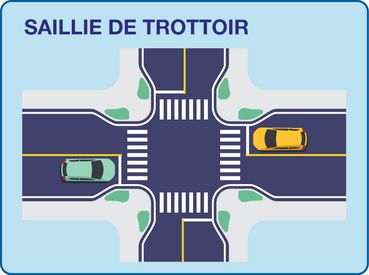
Example of curb extensions at an intersection
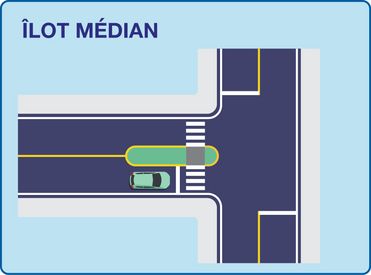
Example of a median island at an intersection.
Pedestrian, speed limit and delineator bollards
Various types of bollards can be installed on the roadway to enhance pedestrian safety, including:
- speed limit bollards
- pedestrian bollards
- delineator bollards
Raised crosswalks and raised intersections
Raised crosswalks and raised intersections are traffic-calming measures designed to slow down vehicles.
With appropriate signage, these features encourage drivers to reduce speed and be more attentive to their surroundings. They also improve visibility and enhance pedestrian safety.
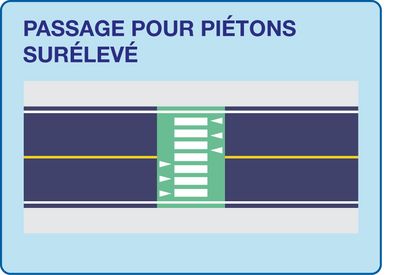
Example of a raised crosswalk
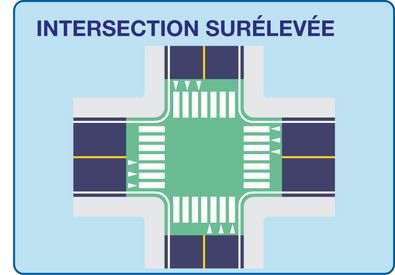
Example of a raised intersection
Second level of intervention
When the measures described above are not sufficient to ensure pedestrian safety, a second level of intervention may be considered. This level focuses on redesigning intersections, specifically through curb radius reductions (also known as corner tightening).
Reducing corner radii requires drivers to slow down when turning and shortens the crossing distance for pedestrians. Corner radii can be reduced using concrete curbs, pavement markings or bollards.
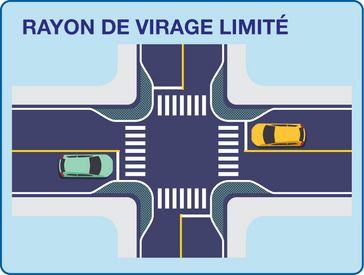
Example of smaller corner radii at an intersection
Third level of intervention
When the measures from the two previous levels are insufficient to ensure pedestrian safety, a third level of intervention may be considered. This level focuses on environmental design.
Measures at this level may include, for example:
- the installation of median islands at the entrances to residential areas
- features that limit a driver’s visual field
- the addition of street furniture in built-up areas
These measures signal a change in the surrounding environment and encourage drivers to comply with posted speed limits.
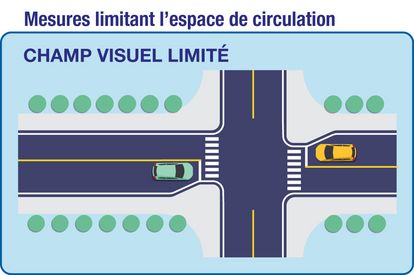
Example of a measure limiting visual fields at an intersection
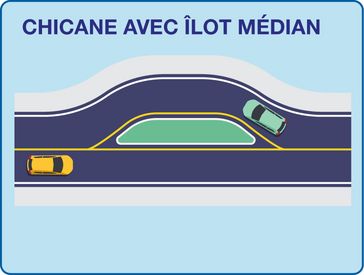
Example of a chicane with a median island
See also
Last update: July 13, 2026