- Home
- Transports
- Traffic and road safety
- Traffic rules and tips for all vehicles
- Stopping a vehicle on a public road
Restrictions on stopping a vehicle on a public road
You are not allowed to stop your vehicle on a public road unless it is absolutely necessary, such as in the case of a mechanical breakdown.
You cannot stop your vehicle on a public road in such a way that it will:
- Mask a sign or signal, rendering it ineffective.
- Obstruct traffic.
- Hinder the performance of work or the maintenance of the road.
- Block access to a property.
Places where it is prohibited to stop your vehicle
Except where another provision of the Highway Safety Code permits it, you are prohibited from stopping your vehicle in certain specific locations.
Here are some examples of places where you are prohibited from stopping your vehicle:
- on a sidewalk or median strip
- less than 3 m from a fire hydrant
- at an intersection, on a pedestrian crosswalk or bicycle crossing
- in a traffic circle
- in a loading and unloading zone or a zone reserved exclusively for road vehicles assigned to public transportation
- on a bridge or a viaduct, or in a tunnel
- on a limited-access roadway (e.g., autoroute) and on an entrance or exit ramp to such a roadway
- in a traffic lane reserved exclusively for certain vehicles (e.g., buses, bicycles)
- in front of a sidewalk ramp specially built for persons with disabilities
- at any place where parking is prohibited by a sign
Lastly, you are not allowed to stop your vehicle on a road where the maximum speed limit is 70 km/h or more, except in cases of necessity (e.g., mechanical breakdown) or unless authorized by signage.
Stop sign to be obeyed
You are also not allowed to stop your vehicle, not even for a few seconds, in areas designated by the following sign.
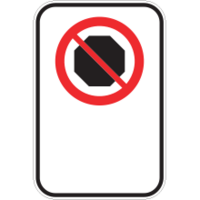
Sign indicating a “no stopping” zone.
See also
Last update: July 13, 2026