- Home
- Transports
- Traffic and road safety
- Traffic rules and tips for all vehicles
- Traffic lanes
- Roadways with a two-way centre lane
Rules for driving on a roadway with a two-way centre lane
A roadway with a two-way centre lane is part of a public road designed to enhance the safety of cyclists.
Developing a roadway with a two-way centre lane may be considered in places where traditional types of cycling facilities, such as bike lanes and bike paths (physically separated from motor vehicle traffic) are not feasible, for example, if the public road is too narrow.
Did you know?
Roadways with a two-way centre lane, also known as advisory bike lanes, advisory shoulders or edge lane roads, are popular in Europe on low-volume and low-speed roadways. More recently, this design concept has also been adopted in North America, particularly in Ottawa (Ontario), in Victoria (British Columbia) and in a number of U.S. states.
Pilot project currently under way
In Québec, the roadway with a two-way centre lane is in its experimental phase and is currently being studied in a pilot project. The
The city of Bromont was the first to develop a roadway with a two-way centre lane in its territory. This roadway, located on Chemin de Lotbinière, has been in place since July 2024.
Design of a roadway with a two-way centre lane
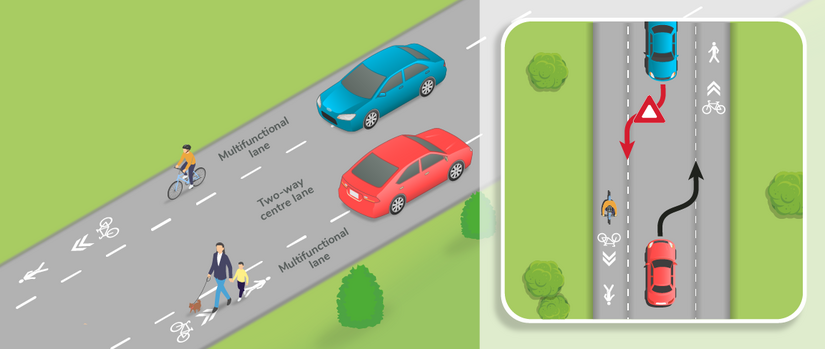
A roadway with a two-way centre lane consists of a two-way centre lane, where road vehicle traffic travels in both directions, bordered by two multifunctional lanes.
Multifunctional lanes are primarily designed for cyclists. They are also intended for motorized personal mobility devices (e-scooters, electric unicycles, etc.), motorized mobility aids (electric wheelchairs, three-wheel mobility scooters, four-wheel mobility scooters) and, when no sidewalks are present, pedestrians.
Signage
Signage (signs and ground markings) tells users that the roadway is shared between multifunctional lane users and drivers of road vehicles.
The following sign indicates the start or the continuation of a roadway with a two-way centre lane.
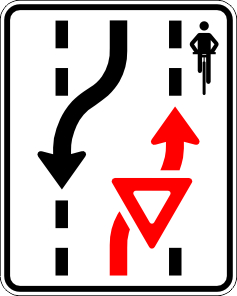
Broken white lines separate the centre lane from the multifunctional lanes, which are identified with a bicycle symbol and two chevrons above it. In the absence of a sidewalk, the multifunctional lanes also include pedestrian symbols.
Driving a road vehicle on a roadway with a two-way centre lane
If you are driving a road vehicle, you must use the centre lane.
You must slow down when you meet another road vehicle heading in the opposite direction or if there are any users in the multifunctional lanes.
The following images show the most common situations on the roadway with a two-way centre lane. Find out how you should behave in such situations.
Road vehicle alone on the roadway
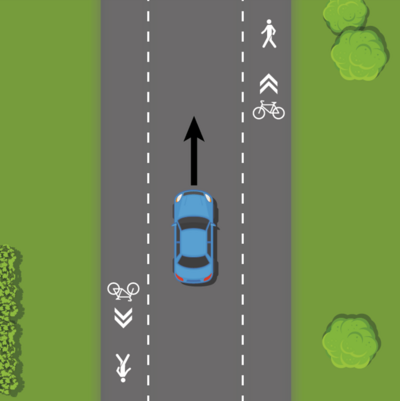
If a road vehicle is alone on the roadway, it must remain in the two-way centre lane.
Road vehicle sharing the roadway with pedestrians or cyclists
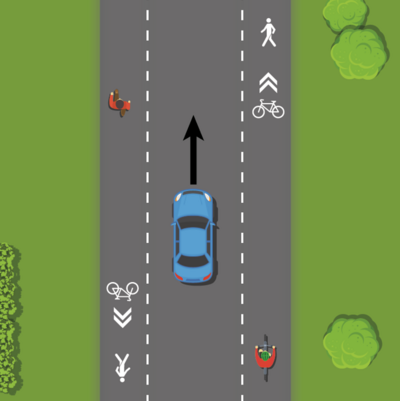
In the presence of pedestrians or cyclists, the road vehicle must slow down and remain in the two-way centre lane, at least 1 m from the pedestrian or cyclist. Pedestrians and cyclists must use the multifunctional lanes.
Two road vehicles passing each other
When two road vehicles pass each other, each must slow down, encroach on the right-hand multifunctional lane, then return to the two-way centre lane once the passing manoeuvre is complete.
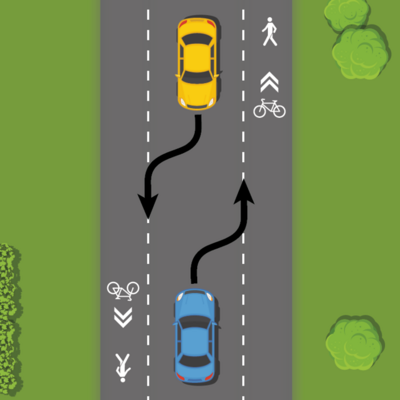
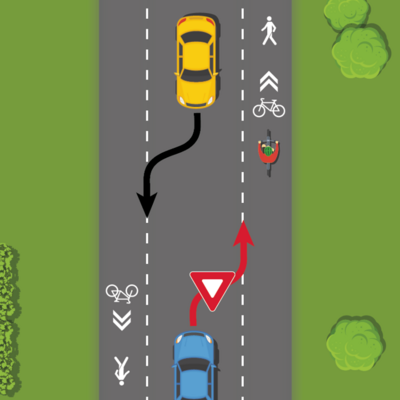
Two road vehicles passing each other in the presence of pedestrians or cyclists
When two road vehicles pass each other in the presence of pedestrians or cyclists, each vehicle must slow down and yield to the pedestrian or cyclist. They may then encroach on the right-hand multifunctional lane and, once the passing manoeuvre is complete, return to the centre lane.
If the driver of the vehicle cannot encroach on the multifunctional lane, they must stop in the centre lane until it is safe to encroach.
Bringing a road vehicle to a full stop
The driver of a road vehicle may not bring the vehicle to a full stop on a roadway with a two-way centre lane, except in a case of necessity, or if it can be done in safety, in the following cases:
when parking spaces or a shoulder wide enough to allow parking are available
to enable a person with a physical disability to get in or out of the vehicle
Riding a bike or motorized personal mobility device (MPMD) on a roadway with a two-way centre lane
If you are riding a bicycle or MPMD (e.g., e-scooter), you must use the right-hand multifunctional lane.
Riding a motorized mobility aids (MMA) on a roadway with a two-way centre lane
If you are riding an MMA (e.g., electric wheelchair, three-wheel mobility scooter, four-wheel mobility scooter), you must use the right-hand multifunctional lane. You may not use the two-way centre lane.
You may use the sidewalk when one is present along the roadway with a two-way centre lane.
Also, you may not use the left-hand multifunctional lane, except:
when the right-hand multifunctional lane and the sidewalk are not suitable for use
to avoid having to cross the roadway more than once over a short distance, or to travel on the lighted side of the public road
Walking on a roadway with a two-way centre lane
When on foot, you must use the sidewalk. If there is none, you must use the left-hand multifunctional lane.
You may also use the right-hand multifunctional lane to avoid having to cross the roadway more than once over a short distance, or to travel on the lighted side of the public road.
Other applicable traffic rules
Aside from the specific rules set out in the Pilot project for traffic on public highways comprising a roadway with a two-way centre lane (described above), road users must comply with the other rules in the
See also
Last update: July 13, 2026