- Home
- Transports
- Traffic and road safety
- Traffic rules and tips for all vehicles
- Driving in the presence of large wildlife
Driving in the presence of large wildlife
Because of the presence of large wildlife (white-tailed deer, moose, bear and caribou) along highways, you need to be alert when driving in Québec. This is especially true in spring and early fall, when the risk of hitting a large animal is greatest.
Safety tips for avoiding collisions
In Québec, between 2021 and 2024, an average of more than 7,200 vehicle accidents involving large wildlife were reported every year. About 90% of these accidents involved a white-tailed deer. When a car collides with a moose, the impact is to the windshield and the front part of the roof. The consequences for the occupants are serious, if not fatal.
The risk of colliding with an animal is greater at dawn and dusk, especially in June and July, as well as in October and November. During these periods, it is important to be more attentive to areas where large wildlife may be present.
To reduce the risk of collisions:
- Obey speed limits and be vigilant in areas where signs indicate the frequent presence of deer (white-tailed deer or moose).
- Scan both sides of the road as far ahead as possible.
- Be careful in areas where visibility is reduced due to curves, slopes or dense vegetation along the roadside.
If a collision with an animal is inevitable:
- Don’t swerve to try to avoid it.
- Brake and slow down gradually.
- Tap your brakes repeatedly to warn drivers following you that an animal is nearby.
- Honk your horn to try to scare the animal away.
Signs and signals warning road users about the possibility of large wildlife in the area
Signs can be installed to warn users of the possibility of wildlife, such as white-tailed deer, moose and caribou, on public roads or their shoulders.
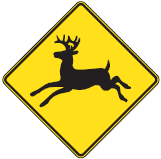
Sign warning users of the possibility of white-tailed deer in the area.
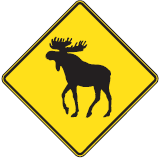
Sign warning users of the possibility of moose in the area.
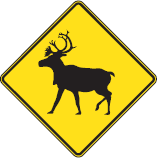
Sign warning users of the possibility of caribou in the area.
There are also signs with flashing yellow lights to warn users of the increased possibility of wildlife in the area. These signs are installed where the number of collisions or the reported presence of animals represents a significantly higher risk of collision for road users.
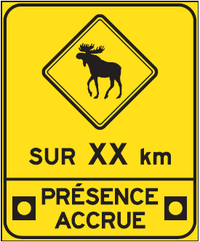
Flashing light to warn users of the increased possibility of wildlife in the area.
Structures installed to minimize the risk of collisions
Special attention is paid to areas where the presence of large animals could cause accidents. Wildlife crossings and exclusion fencing have been installed along certain roads to reduce the risk of vehicle-wildlife collisions.
Wildlife crossings
There are nearly 170 wildlife crossings on the Québec road network, 80 of which are specifically designed for large animals. Wildlife crossings ensure the safe passage of animals across the road, enabling them to reach their habitats.
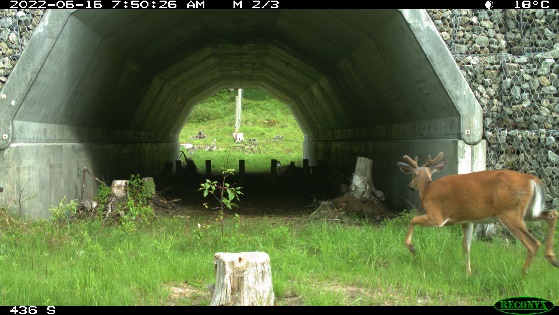
Example of a wildlife crossing under a road.
Wildlife exclusion fencing
Québec currently has more than 475 linear kilometres of wildlife exclusion fencing along several roads where there is a potentially high risk of collision. Exclusion fencing prevents animals from reaching the road and directs them towards wildlife crossings.
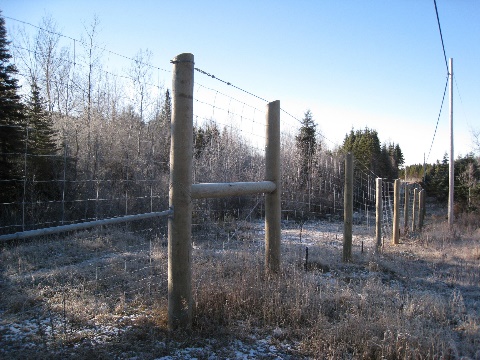
Example of a wildlife exclusion fence on the side of the road.
Report a dangerous situation
Call
See also
Last update: July 13, 2026