- Home
- Agriculture, environment and natural resources
- Wildlife
- Living with Wildlife
- What to do if wild animals are on your property
What to do if wild animals are on your property
Animal movement and relocation prohibited in Estrie, Montérégie and Centre-du-Québec
It is prohibited to move or relocate live raccoons, striped skunks, gray and red foxes, as well as coyotes and their hybrids, within the territory of municipalities (PDF 193 Kb) located around known racoon rabies cases. The rehabilitation of animals illegally transported is prohibited.
If you capture a nuisance animal (raccoon, striped skunk, gray fox, red fox or coyote) and it was not possible beforehand to scare it away or prevent it from causing damage to your property, you have two options:
- Release the animal on site (outside a building);
- Kill the animal (as a last resort). No permit is required in this context, and this may be done outside hunting and trapping seasons. You may use the euthanasia method for animals captured using a cage (PDF 1.74 Mb) (in French only) that complies with international humane trapping standards.
To learn more about the relocation ban, see the Relocating a raccoon? What a bad idea! page.
Squirrels, skunks, raccoons, wild turkeys, coyotes, birds of prey, and other wild animals are sometimes seen on residential properties, both in cities and in the countryside. If they cause damage and become a nuisance, find out how to prevent and control their presence on your property.
Identify the animal responsible for the damage
To help you identify the animal responsible for the damage on your property, you can use this form. Knowing the animal’s habits can help you understand the causes of the problem and then choose appropriate solutions to keep it away.
Complete our questionnaire to identify the animal responsible for the damage and to learn more about the animal in question.
Complete the questionnaire (in French only)
If you think you know the animal responsible for the damage, you can consult the list of nuisance species (French only) to access the information sheets.
Adopt preventive measures
Several simple measures can be used to keep nuisance animals away. They act on the environment or on the animal. Preventive measures have several advantages:
- they can be applied before the animal causes damage;
- they apply to several animals at once;
- they prevent the development of harmful behavior.
However, an animal that has already developed bad habits is more difficult to drive away.
You must ensure that your property no longer offers anything of interest to it (no shelters, no sources of food, and the planting of tree, shrub, plant, and flower species that do not attract the animal, etc.).
For preventive measures specific to birds of prey, consult the page Preventing problems that may be caused by birds of prey (French only).
Block attic and chimney openings
Block all the openings in your attic space and chimney with sturdy wire mesh with 1-cm openings. Before sealing the exits, make sure that no animals are inside. Otherwise, their attempts to get out could cause major damage.
Trim trees located near buildings so that there is more than three metres of clearance, to prevent animals from reaching them. Wire mesh does not stop animals from climbing trees, but it does prevent hares and rabbits from gnawing the bark.
Cover the chimney opening with 1-cm mesh or with a chimney cap specially designed for this purpose. The mesh must not allow leaves to accumulate and block the chimney.
Block openings in buildings, sheds, and porches
Properly close off all access to the building (doors, windows) and block all openings with wire mesh. Use mesh with 5-cm openings against raccoons, groundhogs, and skunks, and 1-cm openings against squirrels.
Prevent access beneath buildings and porches with wire mesh. Part of this mesh must be buried in the ground, about 15 cm deep. It must also be bent outward in an L-shape (40–50 cm).
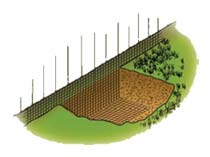
Example of wire mesh buried in the ground and bent outward in an L-shape. © Ministère de l'Environnement, de la Lutte contre les changements climatiques, de la Faune et des Parcs
Secure garbage cans
Use sturdy metal or plastic garbage cans with tight-fitting lids. It may be necessary to keep the lids tightly closed with strong rubber bands.
Use a device (rope, bracket, etc.) to keep the garbage can from tipping over. Store garbage cans in a box with a hinged lid that is heavy enough or equipped with a locking device (such as a padlock). Some animals are clever.
Change your habits. Most small mammals are nocturnal. Set your garbage cans out only on the morning of garbage collection day, rather than the night before.
Reduce odors by washing your garbage cans regularly. Place mothballs (naphthalene) in the bottom.
Secure bird feeders
Hang bird feeders using a long, thin metal wire.
Install an inverted cone above the feeder if it is hanging or on the post if it is anchored in the ground. This cone must be able to move so that animals cannot get a grip on it.
Place the feeder at least 1.5 metres off the ground and 3 metres away from any place a squirrel could jump from: tree branch, porch railing, shed, roof, etc. You can also purchase so-called squirrel-proof feeders.
Remove pet food
Do not leave food for a domestic animal (cat, dog, stray cat) outside your house. This is an easily accessible food source and therefore very attractive to nuisance wildlife. If you must absolutely leave a small amount of food outside for a pet, do so preferably for very short periods and only during the day.
Do not feed wild animals. This has negative consequences for both them and humans (in French only).
Protect trees, bulbs, and vegetable gardens
Install wire mesh (chicken wire) over bulbs at the soil surface. You can use this mesh to make a basket with sides about 10 cm high. Be sure to place it upside down over the bulbs before covering them with soil. This way, animals cannot reach them, either from the sides or from below. Mesh does not harm the bulbs; young shoots simply grow through it.
After planting the bulbs, you can spread a mulch made of prickly, irritating material such as dried pine needles or spruce branches. This can have a deterrent effect on squirrels that might want to dig around the bulbs.
Protect the base of trees with a 50-cm-high wire mesh cylinder, burying about 10 cm of it in the ground.
Protect vegetable gardens by fencing them with 100-cm wire mesh, part of which (15–30 cm) must be buried in the ground and bent outward in an L-shape (40–50 cm).
Use repellents
Repel the animal by using repellents. These products target the animal’s senses. There are visual repellents (scarecrows), auditory repellents (propane cannons), odor-based repellents (naphthalene), and taste-based repellents (thiram).
Control wild animals on your property
If preventive measures have proven ineffective, you can then turn to control methods, that is, capture. Any intervention involving a wild animal must first aim at its valorization and the conservation of resources. Capturing a species should always take place in the context of a legal harvest (hunting or trapping) and for a specific use (sale of fur or consumption of meat).
Control methods should be used with great caution. They do, however, have advantages to consider:
- they prevent the animal from moving to other locations;
- they allow for the valorization of wildlife during the hunting and trapping season for meat and fur.
These methods must be applied in compliance with regulations. Capture must, in particular, be subject to a permit application for scientific, educational, or wildlife management purposes (French only). Contact us if in doubt.
Practice hunting and trapping in season
When regulations allow, you may hunt and trap species recognized as game (French only) or furbearing animals (French only). By doing so, you are engaging in an activity of wildlife valorization that also helps reduce the problems these animals cause you.
Consult the regulations on sport hunting and trapping.
Capturing an animal with a lethal trap or shooting it with a firearm
If your preventive measures have proved unsuccessful, you may capture the animal with traps or shoot it, even outside the regulated hunting and trapping seasons. No authorization is then required. However, you must report to a wildlife protection officer any animals that are on the mandatory-report list and surrender them if the officer so requires.
Comply with applicable regulations
It is strongly recommended that you consult specialized firms or your
Do not relocate the animal
In all cases, it is strongly discouraged — and may even be prohibited — to relocate wild animals far from their place of capture. When an animal is moved from an area where it found food and shelter, and those resources remain available, it is only a matter of time before another animal takes the displaced animal’s place. The problem will recur.
Each relocation of wild animals increases the risk of introducing new diseases or parasites into a region where they are absent. Thus, relocation can have significant harmful consequences for public health, agriculture, or the conservation of threatened species.
Moving an animal can help perpetuate its nuisance behaviour in another area. This can be even more problematic if the animal is aggressive toward people.
Control by poisoning
Poisoning should be used only as a last resort and only after all other control methods have been tried unsuccessfully. This method can have harmful effects on non-target animals, predators, and the environment. Follow all necessary safety precautions when handling products and ensure that you use only authorized, over-the-counter products. The use of chemical products is regulated. Some may be used only by accredited nuisance-animal control firms.
Information on wildlife in Québec
-
Monday, Tuesday, Thursday and Friday: 8:30 a.m. to 4:30 p.m.
Wednesday: 10 a.m. to 4:30 p.m.
-
Toll-Free number: 1-877-346-6763
-
See also
Last update: August 21, 2026