- Home
- Agriculture, environment and natural resources
- Québec’s Biodiversity
Québec’s Biodiversity
Biodiversity (or biological diversity) refers to the variety of life on Earth. It includes all plants, animals, and other living organisms, as well as the places where they live and the ways in which they interact with one another and with their environment.
The loss of biodiversity can compromise the health of our planet and global food security. This issue is therefore a matter of concern, both globally and locally.
Understanding biodiversity
Each ecosystem represents a component of the biodiversity of a specific territory. In order to preserve the various ecosystems that are essential to protecting species and their habitats, land conservation is crucial. It also contributes to the maintenance of ecological services.
Ecosystem
An ecosystem is a group of plants, animals, and other organisms that live together in a specific area and interact with one another and with their environment. Ecosystem size can vary greatly: it can be a tree stump, a small pond, or even an entire ocean.
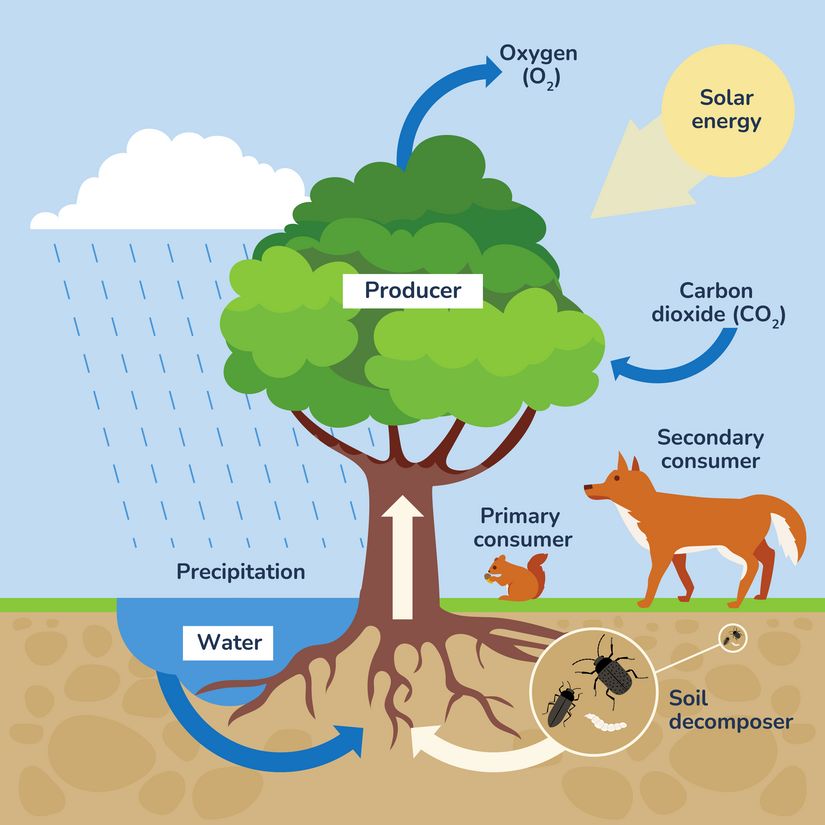
Ecosystem. © Freepik
Habitat and ecological corridors
A habitat is a place that brings together the conditions necessary for the survival of a species or population. It is an essential part of an ecosystem. One ecosystem may contain multiple habitats that contribute to the overall diversity and structure of the ecosystem.
Habitats provide animals with shelter, food, and breeding grounds. Many animals require different habitats over the course of their lives. For example, northern map turtles (in French only) lay their eggs on land, but outside of that period they primarily inhabit aquatic environments. Connectivity between different types of habitats is therefore essential to their survival.
This connectivity is made possible by
Ecological services
People benefit daily from the services provided by species and natural environments, known as ecological services. These services are often grouped into four categories:
- Regulating services help maintain the balance of the environment in which we live. These include climate regulation and the purification of air and water.
- Provisioning services provide the resources necessary for our well-being and comfort, such as food and fresh water.
- Ontogenetic services (related to individual development) contribute more specifically to the development of the immune system and to human well-being.
- Sociocultural services refer to non-material benefits related to human interactions with the environment, such as the enjoyment of recreational activities or the educational value offered by nature.
Here are some examples to better understand how ecological services influence our quality of life.
Water purification
Ponds, marshes, swamps, and bogs are all types of wetlands. Some of these wetlands, particularly those located along lakes and watercourse, are considered the “kidneys of the planet”: they serve as natural filters for pollutants, thereby improving water quality.
Wetlands slow down the movement of water, promote sedimentation, and intercept pollutants. The plants and microorganisms that inhabit these environments absorb pollutants and transform them into simpler and less harmful compounds.
For example, in agricultural areas, wetlands can make a significant contribution to retaining nitrates and phosphates. Wetlands also help trap contaminants such as heavy metals in their soil. Once bound to bottom sediments, these metals become less reactive and are less likely to be absorbed by living organisms.
Wetlands therefore help reduce the impact of fertilizers and other contaminants on water quality and aquatic ecosystems.
Air purification
Plants—especially trees—capture many air pollutants. They act as natural filters.
Trees help eliminate pollutants from the air through their stomata, which are tiny pores located on the underside of their leaves and serve for gas exchange. Some atmospheric contaminants (dust, pollen, ash) can be absorbed by the tree’s tissues—trunk, branches, and leaves. However, the rate of absorption varies by tree species.
By purifying the air, plants and trees help reduce the risks of respiratory illnesses and cancer in humans.
Soil fertility
Some small organisms that live underground are essential to soil fertility. Within a single square foot of soil, one can find nearly 50,000 mites and insects, as well as 12 million worms. Similarly, a single gram of soil may contain approximately 30,000 protozoa (unicellular organisms), 50 algae, 400,000 fungi, and billions of bacteria.
The earthworm is a prime example of an indispensable organism. It transforms agricultural waste into nutrients essential to plant growth. When crop residues are left on the soil, earthworms feed on them, converting plant matter into fertilizer. As they move through their tunnels, they release this fertilizer near the plant roots, where it is most needed.
Other soil organisms help transform nutrients into forms that plants can absorb. For instance, rhizobium bacteria live in nodules attached to the roots of legumes such as peas, beans, soybeans, clover, and alfalfa. They capture nitrogen from the air and deliver it directly to the host legume, which needs it for growth. For most other plants, nitrogen must come from decomposing organic matter or from the continual application of nitrogen fertilizers by farmers.
Certain fungi—such as mycorrhizae—form symbiotic associations with plant roots and help them absorb necessary nutrients like phosphorus and nitrogen. These fungi account for more than 25% of the microbial biodiversity in soil.
Fertile soils are essential to biodiversity and natural cycles. They promote plant growth, provide oxygen, and support food chains. Healthy soils also store carbon, helping to mitigate climate change.
Microclimate regulation
Microclimate regulation refers to the way trees and other environmental elements can alter weather conditions in a small area.
For example, in urban settings, trees cool the air in two ways:
- Directly, by blocking solar rays;
- Indirectly, through transpiration (the release of water vapor through leaves).
By properly positioning trees on their property, a homeowner can reduce summer air-conditioning costs by nearly 60%. Even in winter, coniferous trees can reduce wind speed, thereby lowering heating costs.
Global climate regulation
Global climate regulation refers to natural processes that influence Earth’s climate.
For example, peatlands and forests are valuable allies in the fight against climate change. They act as carbon sinks by capturing and storing carbon dioxide (CO2) in soil and trees during their growth.
As a result, the CO2 stored in these ecosystems does not contribute to the greenhouse effect or to climate change.
Mitigation of floods and droughts
Wetlands and flood zones help retain and absorb rainwater and melting snow. Generally, vegetation presence helps regulate stream flow and contributes to flood and drought mitigation.
Without vegetation, river flooding during heavy rainfall could increase by up to 40%. Estimates suggest that a 5% increase in a city's forest cover could reduce runoff volume by about 2%, thereby lowering the costs associated with large-diameter storm sewer systems.
Conversely, when rainfall is scarce, some wetlands and forested areas gradually release stored water, helping to prevent droughts. During drought periods, rivers fed by forested areas may have flow rates three to five times higher than rivers in open areas such as farmland or grasslands.
Health benefits
Access to nature promotes physical and mental well-being. A walk in the forest can help reduce stress. Spending time in natural environments also lowers the risk of developing certain illnesses.
The health benefits are real: the
Watch the video “
Threats to biodiversity
Several human activities and climate change pose threats to biodiversity, including:
- Ecosystem transformation – For example, the destruction of wetlands for urban development may result in the loss of critical breeding habitat for certain species;
- Increase in invasive alien species (in French only) – For instance, the introduction of species such as Eurasian watermilfoil into Québec lakes degrades local ecosystems and impacts socioeconomic activities (swimming, fishing, boating, etc.);
- Decline in environmental quality – For example, the pollution of watercourses by certain industrial or agricultural discharges contributes to eutrophication, which in turn promotes, among other things, the proliferation of blue-green algae and reduces water quality for fish and other aquatic organisms;
- Climate change – For instance, shoreline erosion can disrupt marine and terrestrial ecosystems that depend on these environments, including species and their habitats;
- Resource exploitation – For example, tree harvesting at unsustainable rates can destroy critical forest habitats for certain species.
Conserving land to protect biodiversity
It is important to curb biodiversity loss throughout Québec, particularly to:
- Preserve ecosystems and the ecological services we depend on;
- Strengthen community resilience to climate change and other environmental challenges;
- Maintain quality of life and human well-being.
To achieve these objectives, natural environments and their ecological functions must be integrated into Québec’s land-use planning and development.
Several actions can be taken, including:
- Creating
protected areas to safeguard significant natural environments; - Designing programs and other initiatives to restore degraded natural environments;
- Promoting sustainable agriculture;
- Developing green infrastructure;
- Raising public awareness and encouraging everyone to contribute to these efforts to the extent of their abilities.
Actions to preserve biodiversity
Maintaining healthy biodiversity is essential to our survival. Since human activities are partly responsible for biodiversity loss, everyone must do their part.
Here are some simple and practical actions.
Report your observations
During a walk in nature, observe plant and animal species. Your sightings can help support species conservation and improve scientific understanding.
If you believe you have observed a species at risk, report it (in French only) to the Centre de données sur le patrimoine naturel du Québec (Québec Natural Heritage Data Center).
You can also submit sightings of other plant or animal species to various citizen science platforms, such as:
Neighbourhood Bat Watch – for bats;eBird – for birds;Carapace – for turtles;iNaturalist (in French only) – Projects – Québec Natural Heritage Data Centre – for plant and animal species;- iPêche (in French only) – for Québec’s freshwater fish;
Atlas of Amphibians and Reptiles of Québec (in French only) – for amphibians and reptiles.
Respect hunting, fishing and trapping regulations
Learn about hunting, fishing, and trapping regulations before engaging in these activities. Always follow zone-specific regulations, open seasons, and quota limits to help sustain animal populations over the long term.
The mandatory registration of certain species helps accurately assess population status to avoid overharvesting that could destabilize ecosystems.
Adopt responsible fishing practices
As a recreational fisher, you can contribute to responsible fish population management and environmental protection by following good practices and joining the Je pêche responsable initiative.
Harvest plant species responsibly
If you wish to harvest plant species, make sure to identify them properly to avoid harvesting threatened or vulnerable species (in French only). Act responsibly by harvesting only part of the plant and leaving some individuals in place. These actions help prevent the loss of species and their habitats and support biodiversity conservation.
Report illegal activities
Have you witnessed an activity that could harm the environment, such as illegal dumping or the discharge of toxic substances into a waterway? Submit an
Have you witnessed poaching or any action likely to harm wildlife? Report it to SOS Poaching – Wildlife Emergency.
Be vigilant about invasive species
Several invasive species established in Québec originate from foreign countries. Introduced through human activities (e.g., the release of exotic pets into the wild, uncleaned recreational watercraft, etc.), they can have a major impact on local biodiversity.
There are best practices to prevent their spread. If you believe you have seen an invasive species, report your observation using the Sentinelle tool (in French only).
Leave wild animals in the wild
Many wild animals leave their young alone for varying lengths of time. If you observe one, do not intervene. These young animals have developed instincts to survive in their natural environment. Attempting to rescue them often results in making them orphans and reducing their chances of survival.
To learn more, consult the web page Best practices when encountering wild animals (in French only).
Support a biodiversity conservation organization
By volunteering your time or making a donation to one of the organizations working to protect biodiversity, you are directly contributing to preserving ecosystems, protecting endangered species, and promoting sustainable practices. In doing so, you will help ensure a sustainable future for our planet.
See also
Last update: June 1, 2026