- Home
- Housing and Territory
- Heating and energy consumption at home
- Grants for retrofits
- Rénoclimat financial assistance
- Energy evaluation
- Blower door test
Blower door test to detect air leaks
A blower door test is conducted during each Rénoclimat energy evaluation.
This test measures the airtightness of a home and identifies the location and extent of air leaks.
Detecting air leaks
The blower door test uses a device to assess the airtightness of your home by measuring the amount of outdoor air infiltrating your home.
The test lasts approximately 30 minutes and is part of the energy evaluation, which can take 2 to 3 hours.
During the test, the Rénoclimat advisor inspects your home to locate air leaks.
We recommend accompanying the advisor and taking notes: they will show you where unwanted air leaks are and how to effectively seal them.
Sealing air leaks can be done at a minimal cost, enhancing indoor comfort and reducing energy consumption.
What is a blower door?
The device used during the blower door test is called a blower door.
A blower door consists of:
- a fan;
- airtight nylon fabric;
- a manometer (pressure measuring device).
The fan and its surrounding nylon fabric are mounted on an adjustable door frame, installed in the main entrance of the home for the duration of the test.
It's not necessary to remove the door; you just need to open it.
The fan operates at various speeds, creating a slight depressurization in the home.
The manometer measures the airflow through the fan and the pressure on the fabric.
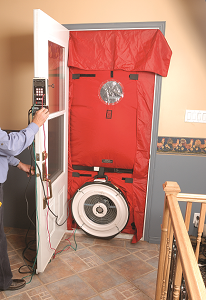
Inside view
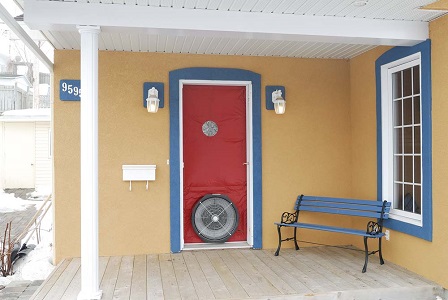
Outside view
Test procedure
Before conducting the test
Before starting the test, the Rénoclimat advisor prepares your home:
- They close all openings leading outside: windows, doors (except the one with the blower door), and ventilation doors.
- They close doors to unheated areas like the attic, garage, or crawl space.
- They open interior doors to allow air circulation throughout the home.
- In rooms with a suspended ceiling, the advisor lifts ceiling tiles to prevent any damage to the ceiling.
Gas and oil-burning furnaces are shut off for safety reasons.
Fireplace vents and doors are closed. Ashes should be removed by the homeowner before the visit to avoid messes.
Measurements
The advisor sets up the device and starts the fan.
To prevent any unpleasant surprises, the advisor starts the fan at low speed and quickly inspects the house to ensure everything is in place.
The pressure gauge indicates the airflow rate per minute required to keep your home at a constant pressure.
The advisor repeats this process at different pressures and compares the data collected to estimated values based on the home's volume.
These measurements estimate the amount of air naturally infiltrating through the building envelope. The total area of these air leaks will be noted in the homeowner information sheet.
Locating air leaks
After taking measurements, the advisor keeps the fan running and inspects all rooms to detect air leaks. They use their hand or a smoke puffer to find them.
Note the locations of these leaks to know how to improve your home's airtightness.
Air changes per hour rate
A home's airtightness level is expressed as the air changes per hour (ACH) rate, calculated from the manometer readings.
This rate will be included in the energy evaluation report of your home, along with the target rate achievable through air sealing work.
If you reach or exceed this air change rate target after the work is completed, you could receive between $400 and $800 of Rénoclimat financial assistance.
To learn more
 Previous
Last update: December 10, 2025